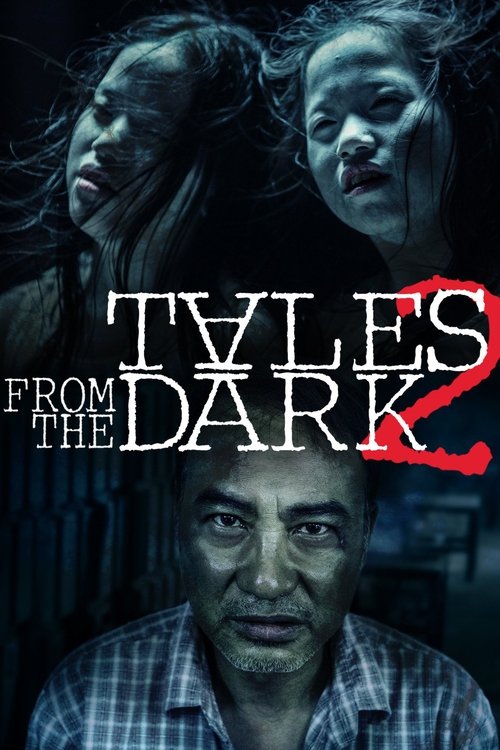
Tales from the Dark 2
Plot
In "Haunted Pillow," TVB starlet Fala Chen is still obsessed with her lover (Gordon Lam) after their breakup and invariably suffers from insomnia. She gets hold of a Chinese herbal pillow that eventually helps her fall asleep again but it also draws her near something unexpected. "Hide And Seek" casts a group of young newcomers into an abandoned school campus where they meet longtime janitor Mr. Chan who takes shelter at the school. Playing hide-and-seek after midnight, the teenagers go missing, one after another. In his self-directed piece "Black Umbrella," Teddy Robin makes solving conflicts on the street at night his mission and marks each closed case with his signature black umbrella. Before he calls it a day, he meets a prostitute who forcefully pulls him upstairs for business and unfortunately things spiral out of control.
Get the Weekly Woke Watchlist
New and trending movies scored for woke bias, preachy messaging, and forced political themes — before you waste your evening.
No spam. One useful email per week.
Overall Series Review
Categorical Breakdown
The movie is a Hong Kong production featuring an all-Chinese cast with stories set firmly in a contemporary Chinese cultural context. The plot conflicts revolve around personal horror, revenge, and murder, with no elements of systemic oppression lecturing, vilification of 'whiteness,' or forced insertion of diversity. Character casting and motivation are based on the narrative needs of a local ghost story anthology.
The film uses Hong Kong locations, Cantonese dialogue, and local folklore like the Ghost Festival, demonstrating cultural familiarity and engagement, not self-hatred. The 'Black Umbrella' segment satirizes the ungratefulness of Hong Kong citizens and includes minor satire of a local politician, indicating internal social commentary rather than broad civilizational demonization. The emphasis is on specific urban vices and traditional ghostly justice.
The 'Pillow' story centers on a female protagonist who is obsessive and kills her boyfriend, leading to her possession by an incubus, which undermines the 'perfect female lead' or 'Mary Sue' trope. The prostitute character in 'Black Umbrella' expresses a desire for a family and children, which directly counteracts an anti-natalist message. Men are depicted as both victims (the murdered boyfriend, the thug) and protectors/moralizers (Uncle Lam), indicating non-uniform gender dynamics rather than male emasculation.
The plots contain no focus on alternative sexualities, gender ideology, or a critique of the nuclear family structure. The main relationship dynamics, however dark or dysfunctional, are heterosexual. Sexuality is depicted in the context of horror (the incubus) or transactional vice (the prostitute), not as a vehicle for sexual identity politics.
The core of the anthology relies on traditional Chinese spiritual concepts like ghosts, demons, an incubus, and the Mid-Summer Ghost Festival. The film's horror operates on a clear spiritual/supernatural premise that affirms a transcendent reality and moral consequence (Uncle Lam's deeds and true nature). There is no hostility toward religion or promotion of moral relativism; instead, it uses a form of folkloric morality.
Get the Weekly Woke Watchlist
New and trending movies scored for woke bias, preachy messaging, and forced political themes — before you waste your evening.
No spam. One useful email per week.