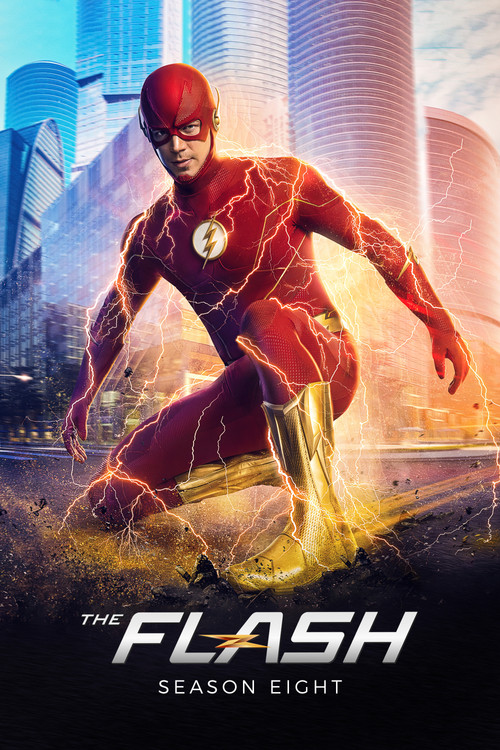
The Flash
Season 8 Analysis
Season Overview
Six months after stopping the Godspeed War, Barry and Iris West-Allen are now at the top of their game—both in their careers as superhero and reporter and as a devoted couple. But when the powerful alien Despero unleashes near annihilation on Central City, The Flash and his team must once again defy impossible odds to save the day. But their victory is short-lived as two new threats rise from the ashes of "Armageddon," one of which will unleash unforeseen horrors into the lives of Barry and his teammates... and change Team Flash forever.
Season Review
Categorical Breakdown
The main supporting cast is predominantly composed of non-white characters who are repeatedly elevated in power and professional standing, with Allegra Garcia and Cecile Horton gaining significant abilities and authority. Cecile’s Black female character continues to 'level up' her metahuman powers and entire career to specialize in defending accused meta-criminals. The police Captain acknowledges her own past prejudices against metahumans, injecting a theme of systemic or personal bias against a minority group into the police institution.
The central themes of the season revolve around saving Central City, protecting the Allen-West family unit, and emphasizing Barry's universal traits of 'compassion' and 'humanity.' The main villains are an alien and cosmic 'forces' that are not proxies for Western civilization or its institutions. There is no notable deconstruction of traditional American or Western heritage, and the main paternal figure, Joe West, remains a moral anchor.
Iris West-Allen is the successful 'Girl Boss' lead of her own expanding media company, and Allegra Garcia is installed in a supervisory position over reluctant subordinates. Cecile Horton's power set is constantly 'leveling up' throughout the season, transforming her from a supporting character into a major, increasingly formidable metahuman, fitting the 'Mary Sue' or 'Girl Boss' power-creep trope. The core couple is shown planning to start a family, which offers a counterpoint to pure anti-natalism.
The season explicitly confirms the main hero's daughter from the future, Nora West-Allen (XS), is LGBTQ+, a fact stated by Barry when he reveals a vision of her 'wife.' This detail inserts alternative sexual identity directly into the future of the core, nuclear family. While not a dominant storyline, this serves to center an alternative sexuality within the hero's direct lineage as a point of positive development.
Religion is largely absent from the narrative, which neither celebrates nor actively demonizes it. The major conflicts center on quasi-spiritual 'Forces' (Speed Force, Negative Forces) which operate as secular, cosmic entities, not traditional religious concepts. There is no evidence of Christian characters being depicted as bigoted or evil, placing the score in the neutral-low range due to the absence of the theme, rather than explicit hostility.