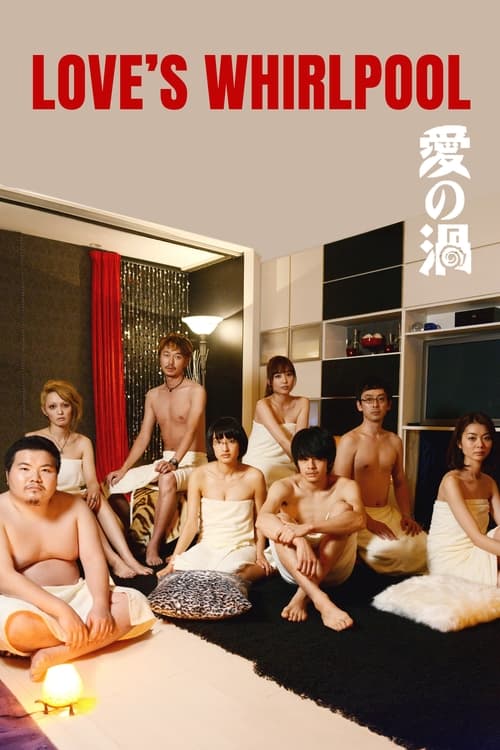
Love's Whirlpool
Plot
A room in a fancy downtown apartment. The evening orgy kicks off with eight men and women meeting for the first time, including an unemployed guy who pays the 20,000 yen party fee with money from his parents, and a female college student whose run-of-the-mill appearance hides a voracious sexual appetite.
Get the Weekly Woke Watchlist
New and trending movies scored for woke bias, preachy messaging, and forced political themes — before you waste your evening.
No spam. One useful email per week.
Overall Series Review
Categorical Breakdown
The film’s critique of prejudice focuses on socioeconomic class, physical appearance, and social type within a homogenous Japanese cast (NEET, salaryman, etc.). Characters face 'scorn' based on their status or physical traits like body odor, illustrating a critique of superficial modern standards rather than a lecture on intersectional hierarchy or the vilification of 'whiteness.' Race is not a factor in the conflict.
The film functions as a specific social critique of contemporary Japanese urban life, portraying it as 'superficial and rather empty' and depicting the sex club as an escape from this modern societal dissatisfaction. This represents hostility toward a corrupted *modern* home culture, but it does not demonize historical ancestors, attack foundational institutions like family/nation, or elevate foreign cultures (the 'Noble Savage' trope).
Gender dynamics are highly non-traditional and challenging. The narrative explicitly equalizes the sexual desire and objectification of men and women, requiring men to respect explicit consent rules. The college student is revealed to possess a 'powerful hidden sex drive,' defying her timid appearance and taking on the 'sexually most aggressive role.' This actively deconstructs traditional female stereotypes and foregrounds female lust, but it stops short of depicting all men as 'bumbling idiots' or promoting a 'Girl Boss' career narrative over motherhood.
The core of the film's conflict is purely heterosexual: four men and four women meeting for anonymous sex. All pairings are male-female, and the drama centers on heteronormative social awkwardness, desire, and connection. There is no evidence of centering alternative sexualities, promoting gender ideology, or deconstructing the nuclear family from a queer theory perspective.
The core thematic underpinning is the spiritual vacuum of modern life and a search for 'meaning in the meaningless sex.' The characters operate in an entirely amoral, secular environment where sex is an attempt to escape 'emptiness,' which establishes moral relativism and the complete absence of a higher moral law. The film is not anti-theist in the sense of attacking traditional religion (specifically Christianity) but reflects a world where objective truth has been entirely abandoned for subjective, fleeting pleasure.
Get the Weekly Woke Watchlist
New and trending movies scored for woke bias, preachy messaging, and forced political themes — before you waste your evening.
No spam. One useful email per week.