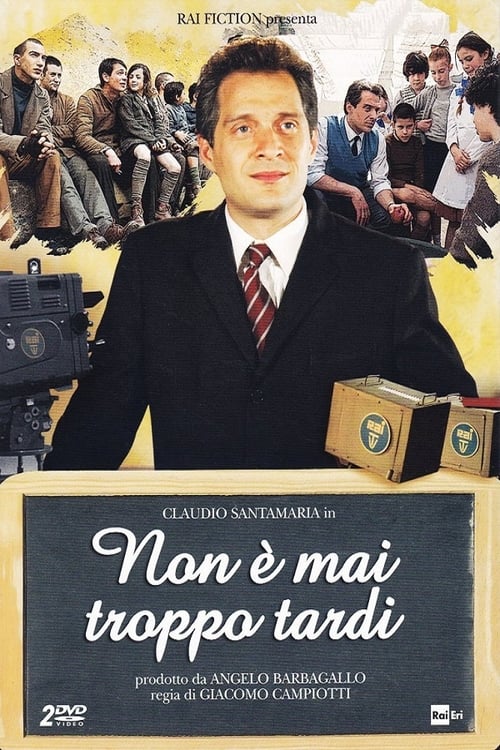
Non è mai troppo tardi
Plot
Alberto Manzi is twenty years old and wants to be a teacher. He gets the job at a juvenile correctional facility, to then get transfered to a proper school, who he deems inadequate. At that time the public broadcasting network Rai decides to realize a program to educate millions of Italians.
Get the Weekly Woke Watchlist
New and trending movies scored for woke bias, preachy messaging, and forced political themes — before you waste your evening.
No spam. One useful email per week.
Overall Series Review
Categorical Breakdown
The story's core is the struggle against illiteracy, benefiting millions of Italian citizens regardless of their regional or social background. The focus is on universal human dignity and the merit of education, which allows individuals to read, write, and gain self-respect. Manzi's philosophy centers on the student's needs and individual potential, a clear model of Universal Meritocracy. Casting is historically authentic, featuring Italian actors portraying Italian historical figures. The conflict is structural (pedagogy vs. bureaucracy), not based on immutable characteristics.
The narrative is a strong affirmation of a civilizational self-improvement project for Italy, focusing on national reconstruction and cultural uplift in the post-war era. Manzi criticizes the inadequacy of the existing school system, but his goal is to reform and strengthen the Italian institution of public education, not to demonize his culture or ancestors. The use of the national public broadcaster (Rai) for mass literacy is portrayed as a positive, unifying act for the Italian nation, which aligns with the principle of institutions as a shield against chaos (illiteracy).
The main focus remains on the male protagonist, Alberto Manzi. The original television program significantly benefited adult women, including homemakers, who made up a large part of the illiterate population, which is an empowering yet non-ideological depiction of women gaining knowledge. Female characters, such as Manzi’s fiancée Ida and the director of 'Telescuola', play supporting and professional roles without the narrative resorting to the 'Mary Sue' or 'Girl Boss' tropes. There is no anti-natal or anti-family messaging present; the dynamics are traditional for the historical setting, celebrating male dedication and complementary social uplift.
Sexual ideology is entirely absent from the narrative. The story is a historical biography focused on education and social reconstruction in post-WWII Italy. The film features traditional male-female pairing as a normative structure for the main relationship (Manzi and Ida). Sexuality remains a private matter and is not centered as an identity or subject for political commentary, adhering to a 1/10 score.
Religion is not a central theme. The film’s moral framework is one of humanist objective truth, where knowledge, self-respect, and a higher moral law of respecting others are promoted through Manzi's pedagogical method. Faith is neither attacked nor celebrated but is simply not the focus. There is no depiction of Christian characters as villains or bigots, and the morality promoted is transcendent, linked to education and the search for knowledge, not subjective power dynamics.
Get the Weekly Woke Watchlist
New and trending movies scored for woke bias, preachy messaging, and forced political themes — before you waste your evening.
No spam. One useful email per week.