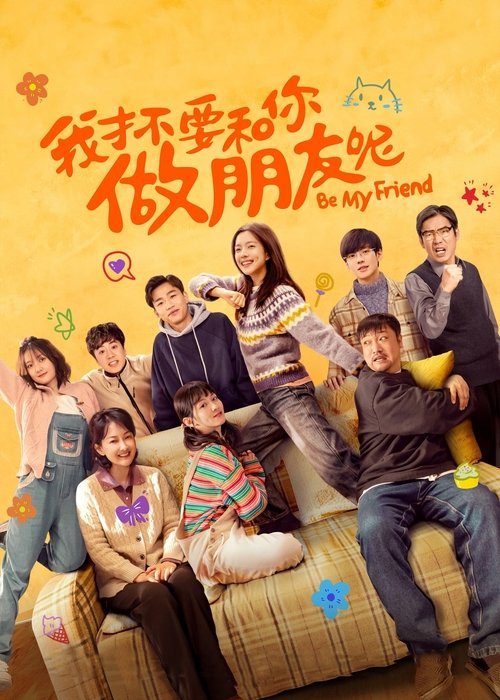
Be My Friend
Plot
17-year-old high school student Li Jinjin (played by Zhuang Dafei) and his mother Li Qingtong (played by Chen Haoyu) have always had numerous conflicts. By chance, Li Jinjin returned to his mother's high school years and broke into her friend circle, the "scrap metal band". When Li Jinjin, who was determined to change his father against the sky, met Li Qingtong and her friends, who were full of emotions and righteousness, their living conditions were constantly changing but full of laughter. A humorous journey of youth is quietly beginning
Get the Weekly Woke Watchlist
New and trending movies scored for woke bias, preachy messaging, and forced political themes — before you waste your evening.
No spam. One useful email per week.
Overall Series Review
Categorical Breakdown
The film's casting and plot are ethnically homogenous and entirely focused on an internal Chinese family drama. Character merits and flaws, such as the father being a 'scumbag,' are based on personal actions (divorcing the mother when she was pregnant) and not on race, privilege, or intersectional hierarchy. The concepts of 'whiteness' vilification or forced diversity are entirely absent from this narrative.
The film depicts a nostalgic return to 1999, specifically showing a 'simpler time' and a stronger 'sense of community' in the home culture of northeastern China. The protagonist's journey leads her to her grandparents, connecting her with her ancestors and heritage in a positive, humanizing way. The narrative framework values the past rather than demonizing it.
The daughter's mission is initially motivated by a desire to prevent herself from being born and to change her mother's life by altering her marriage, which aligns with anti-natalist and anti-family messaging. The mother is a flawed, 'tart-tongued' single parent who gets 'dead drunk,' which subverts the 'perfect Girl Boss' trope, but the daughter is the highly competent, determined female lead trying to control the fate of a man. The score is moderate, reflecting the anti-natalist starting point within a non-'Mary Sue' context.
The core plot is focused on a heterosexual family structure: a mother, a daughter, a father, and the daughter's attempts to change the mother's choice of husband in a strictly male-female pairing. There is no presence of centering alternative sexualities, deconstructing the nuclear family beyond the time-travel manipulation, or any reference to gender ideology.
The film's light-hearted, youth/family drama genre, set in a modern, secularized Chinese context, contains no focus on religion. The narrative does not take a stance on objective moral law or spiritual strength through faith. The score is a low neutral because it does not actively promote hostility toward traditional religion, especially Christianity, but also does not affirm a transcendent moral order.
Get the Weekly Woke Watchlist
New and trending movies scored for woke bias, preachy messaging, and forced political themes — before you waste your evening.
No spam. One useful email per week.