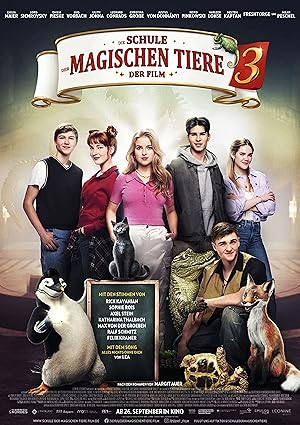
Die Schule der magischen Tiere 3
Plot
Children with magical animal companions at Winterstein School experience adventures spanning a forest and fashion show, encountering a snobbish cat and vegan crocodile while navigating friendship and first love.
Get the Weekly Woke Watchlist
New and trending movies scored for woke bias, preachy messaging, and forced political themes — before you waste your evening.
No spam. One useful email per week.
Overall Series Review
Categorical Breakdown
The cast is naturally diverse, common for modern European cinema, but the primary conflict is based on class (Helene's family bankruptcy) and values (activism vs. fame), not immutable characteristics or race. There is no evidence of intersectional lecturing, vilification of 'whiteness,' or forced 'race-swapping.' The score reflects a non-performative modern diversity.
The central conflict pits 'Forest Day' (local conservation/heritage) against a 'fashion show' (consumerism/modernity). This critiques aspects of modern Western culture (influencer fame, high fashion), a mild form of Oikophobia. The inclusion of a 'vegan crocodile' companion is a clear nod to a modern, ideologically-driven trend. However, the film advocates for local, positive conservation, preventing a high score.
The core A-plot revolves entirely around two young female protagonists (Ida and Helene) and their conflict/ambition, which is a strong 'Girl Boss' focus. The male characters (Jo and Silas) are in a secondary, supporting subplot concerning friendship and first love/jealousy. This emasculates the male role by making the emotional/romantic B-plot subordinate to the female-driven moral/career/activism A-plot. The score is mid-to-high, but it avoids high-end vilification or explicit anti-natalism.
There is no information from reviews or plot summaries to suggest the presence of alternative sexualities, deconstruction of the nuclear family, or gender ideology lecturing. The romantic subplot mentioned is a traditional male-female 'first love' triangle. The score is the lowest possible due to lack of evidence.
As a children's fantasy film, it operates in a secular world where a magical school and magical animals serve as the central spiritual/moral mechanism. The film promotes an objective moral law (conservation is good, greed/vanity is bad). There is no overt hostility toward traditional religion (specifically Christianity). The low score reflects the secular fantasy setting but the presence of clear, transcendent morality (sincerity/protection of nature).
Get the Weekly Woke Watchlist
New and trending movies scored for woke bias, preachy messaging, and forced political themes — before you waste your evening.
No spam. One useful email per week.