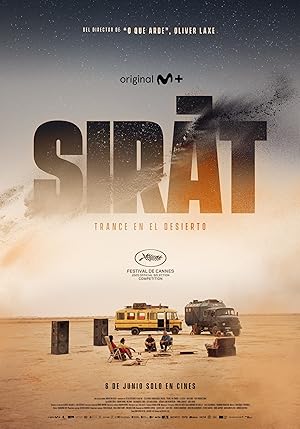
Sirât
Plot
A father, accompanied by his son, goes looking for his missing daughter in North Africa.
Get the Weekly Woke Watchlist
New and trending movies scored for woke bias, preachy messaging, and forced political themes — before you waste your evening.
No spam. One useful email per week.
Overall Series Review
Categorical Breakdown
The plot sets up a conflict where the Spanish, middle-class family man, representing the establishment, is depicted as a 'hapless' and incompetent father who constantly relies on his young son for guidance. This contrasts with the 'misfit ravers,' an 'eclectic group' of non-actors, who form a functional, supportive community in the desert. The narrative champions the 'found-family' of outsiders and those who reject the societal norm over the established structure. The final, shocking turn is overtly political, transforming the characters' suffering into an analogy for the global refugee crisis, centering the plight of the displaced.
The narrative features a strong message of civilizational self-hatred. The father and son represent a home culture that the daughter, Mar, chose to abandon. Ominous radio reports and dialogue confirm that the cities and the world the family left behind are descending into chaos or are 'not worth returning to,' signaling a breakdown of Western institutions. The ravers, living off-grid, are romanticized as a 'found-family' that finds 'heart and soul' in the desert, promoting the 'Noble Savage' trope over the corrupt home civilization.
The film focuses on the central male relationship of the father and son, yet the father is consistently portrayed as 'hapless,' 'adrift in a desert of grief,' and unable to lead without asking his pre-teen son what to do. The daughter's motivation is an explicit rejection and escape from her family unit. The mother is completely absent from the narrative. The traditional male figure is diminished in competency, and the female figure (Mar) is defined by her successful escape from the patriarchal structure, which provides a moderate score.
Explicit themes related to alternative sexualities, sexual identity, or gender theory are not a direct focus of the narrative. The score is not a one because the film explicitly centers the concept of a 'found-family' ensemble and chosen relationships as a superior, more functional alternative to the nuclear family, which serves as a deconstruction of the normative structure. The emphasis on 'radical personal freedom' for the ravers also covers all forms of identity expression.
The title refers to an Islamic concept, the 'narrow bridge' between paradise and hell, but the film's characters 'never mention religion' and no organized faith plays a direct role. Instead, the characters' moral philosophy is one of 'radical personal freedom' and 'complete escape' from societal conventions, living by a 'vibe' and hedonistic existentialism. The film portrays the characters as seeking meaning in a 'spiritual vacuum' and a 'wilderness of non-meaning,' which fundamentally rejects a Transcendent Morality in favor of subjective moral relativism.
Get the Weekly Woke Watchlist
New and trending movies scored for woke bias, preachy messaging, and forced political themes — before you waste your evening.
No spam. One useful email per week.