The Expanse
Season 5 Analysis
Season Overview
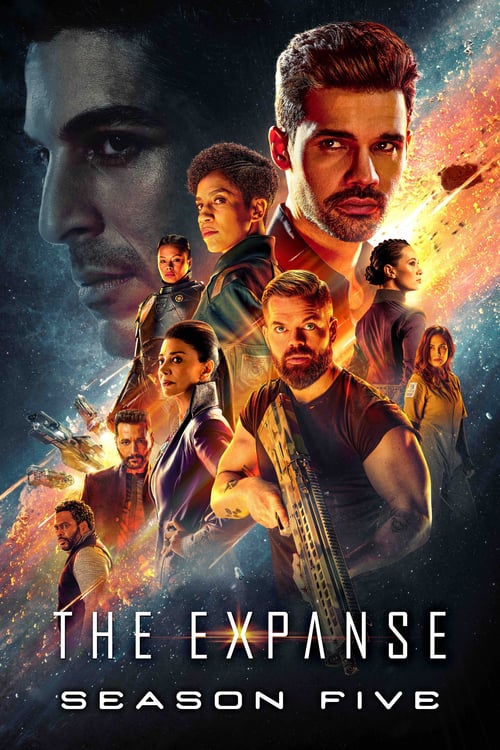
In different parts of the Solar System, the crew of the Rocinante and their allies confront the sins of their past, while Marco Inaros unleashes an attack that will alter the future of Earth, Mars, the Belt, and the worlds beyond the Ring.
Season Review
Categorical Breakdown
The entire geopolitical conflict is structured around a clear oppressor/oppressed dynamic between the 'Inners' (Earthers/Martians) and the marginalized 'Belters,' which explicitly mirrors real-world colonial and indigenous struggles. A major protagonist, Camina Drummer, is an indigenous woman whose arc focuses on her justified rage against the colonizers. The central villain is a Belter terrorist, Marco Inaros, whose actions, while monstrous, are constantly presented as a direct consequence of the Inners' systemic exploitation. The narrative avoids a simple binary, showing the villainy of the oppressed group's extremist faction, but the political structure relies entirely on immutable characteristics (where you were born) and class hierarchy.
Earth, the ancestral home and central civilization, is unequivocally framed as an imperial, oppressive, and decadently wealthy state whose policies led directly to the catastrophic attack it suffers. The devastation of Earth by Marco Inaros's strike is a pivotal, deserved comeuppance for its historical crimes of exploitation and neglect. Protagonist Chrisjen Avasarala, an Earther, acknowledges the failure of her civilization’s leadership. However, characters like Avasarala and Amos demonstrate fierce loyalty and dedication to saving the people of Earth, preventing the narrative from becoming pure self-hatred, instead focusing on systemic corruption.
Powerful women like Chrisjen Avasarala, Naomi Nagata, and Bobbie Draper hold positions of absolute authority as a politician, a highly skilled engineer, and a military operative. These female leads are complex, highly competent, and drive the main plotlines without relying on male figures. Naomi's central emotional conflict is her guilt over abandoning her son, Filip, thereby making motherhood and family trauma a key component of her arc. Drummer’s leadership and emotional decisions are central to the Belt storyline. Male characters remain competent heroes, and there is no overt anti-natalist messaging, balancing the presence of powerful female 'Girl Boss' archetypes.
Camina Drummer is the leader of a functional, central crew that constitutes a polyamorous family, known as a polycule. This non-traditional structure is presented without question as the normal, emotionally-supportive family unit for a major protagonist. The centering of this polyamorous relationship structure as a healthy and viable alternative deconstructs the traditional nuclear family model. Earlier seasons established the world as being post-homophobia, treating same-sex relationships and diverse sexualities as entirely commonplace and a non-issue.
Traditional religion is largely absent from the world's functional politics and character motivations, with morality being entirely transcendent and humanist. The heroic characters operate from a secular, human-centric moral code that values life, mutual cooperation, and responsibility over political vengeance. The show's objective moral framework condemns the atrocities committed by all factions (Inner and Belter), but this condemnation is grounded in humanist principles of protecting innocents and preventing chaos rather than any higher moral or divine law. Faith is not presented as a source of strength or a point of conflict.