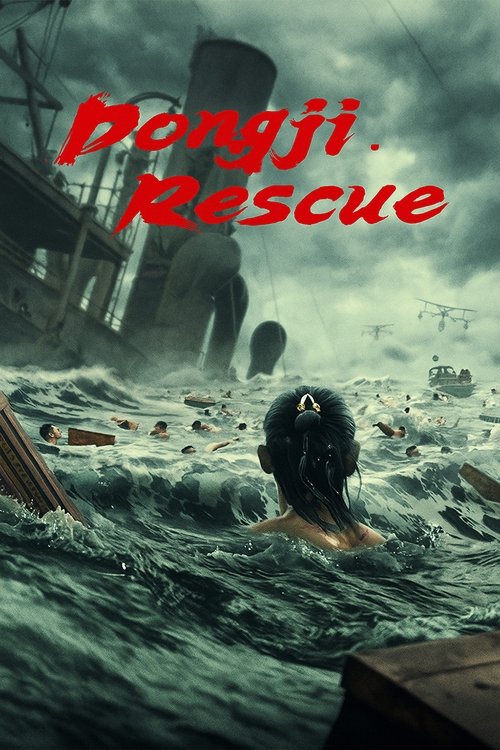
Dongji Rescue
Plot
Inspired by the real life rescue of over 300 British soldiers in 1942, Dongji Rescue is a rousing, action-packed story of heroism on the high seas. When the Japanese warship Lisbon Maru is torpedoed off the coast of Dongji Island, the lives of over 300 British POWs on board are at risk of being claimed by the sea. Their only hope is a small group of defiant Chinese fisherman who will do anything to rescue and protect them from their captors.
Get the Weekly Woke Watchlist
New and trending movies scored for woke bias, preachy messaging, and forced political themes — before you waste your evening.
No spam. One useful email per week.
Overall Series Review
Categorical Breakdown
The plot centers on non-white (Chinese) characters performing an act of self-sacrificing compassion to save white (British) characters, reversing any modern 'intersectional hierarchy' where 'whiteness' would be vilified. The central conflict is historical wartime oppression (Chinese against Japanese military), and the protagonists are celebrated for their universal humanity and courage. Character merit is the sole driver of heroism, not immutable characteristics or political lecturing.
The film fundamentally celebrates the courage, compassion, and strength of the Chinese fishermen and their local culture, contrasting their moral character with the savage brutality of the foreign Japanese occupiers. The narrative frames the home culture and people as heroic and honorable, serving as a powerful act of national and civilizational pride.
The female lead, Ah Hung/Hua, is portrayed as a capable and 'feisty' action heroine who takes a leadership role in the climactic rescue mission. The film features strong, physically capable male protagonists, the brothers Ah Bi and Ah Dang, described as 'studly badasses.' Women are presented as highly competent partners in the action and heroism, but the men are neither emasculated nor depicted as incompetent, reflecting a dynamic of strong, complementary roles rather than a pure 'Girl Boss' trope.
The plot and character dynamics are exclusively focused on the historical wartime rescue and the lives of the traditional island community. The main relationship is a heterosexual coupling, and there is no presence of sexual ideology, alternative sexualities, gender theory, or deconstruction of the nuclear family presented in the narrative.
The story is driven by a transcendent moral decision: the choice to risk everything to save other human lives out of pure compassion. This motivation aligns with a belief in objective moral truth and a higher sense of duty rather than moral relativism. No critique, hostility, or vilification of any traditional religion, including Christianity (which would be the faith of the POWs), is present in the narrative focus.
Get the Weekly Woke Watchlist
New and trending movies scored for woke bias, preachy messaging, and forced political themes — before you waste your evening.
No spam. One useful email per week.