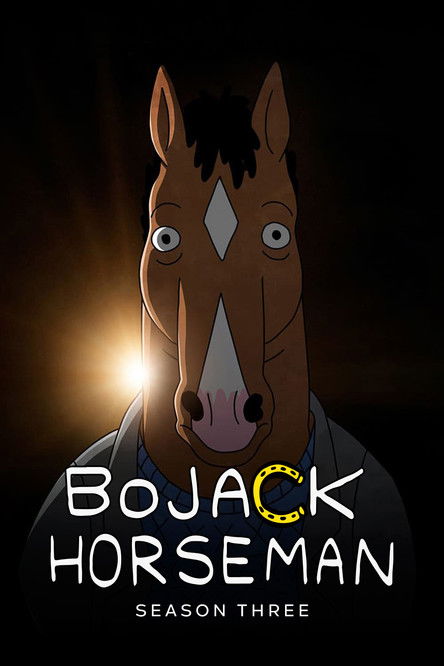
BoJack Horseman
Season 3 Analysis
Season Overview
"Secretariat" is a huge success, and BoJack's finally feeling his oats. But when it comes to his personal life, everything he touches turns to manure.
Season Review
Categorical Breakdown
The narrative frequently holds the privileged male protagonist, BoJack, accountable for his character flaws and systemic abuses within the industry, which acts as a critique of male privilege in Hollywood. The character Diane Nguyen, a Vietnamese-American woman, consistently articulates the show's philosophical and social awareness, contrasting her perspective with the privileged characters. The central conflict is focused on merit and celebrity culture rather than on a general vilification of whiteness.
The show's satirical focus is narrow, concentrating exclusively on the decadence, superficiality, and moral failings of the 'Hollywoo' entertainment industry. The story does not contain overt hostility, deconstruction, or demonization of broader Western civilization, national institutions, or ancestors. The critique remains localized to the morally bankrupt celebrity ecosystem.
A major episode features a storyline concerning a pop star's public abortion, which the narrative treats in a normalized, humorous, and pro-choice manner, framing it as a standard life event. Princess Carolyn's ongoing arc is the definitive 'Girl Boss' narrative, where the pursuit of career power and professional fulfillment forces her to repeatedly sacrifice opportunities for family and motherhood. A subplot directly satirizes men who attempt to profit from or co-opt a shallow, performative version of feminism.
The season finale features a key character, Todd Chavez, exploring his sexuality, culminating in a clear statement that he is neither straight nor gay and 'might be nothing.' This moment centers a major character's sexual identity and explicitly introduces the subject of asexuality, positioning it within the larger framework of a non-heteronormative sexual ideology.
The show is permeated by a worldview of nihilism and existential emptiness, with characters explicitly stating that life is meaningless in a 'Godless Universe.' The narrative explores the devastating personal consequences of this spiritual vacuum, suggesting that there is no objective moral truth or higher law, only subjective moral struggles and destructive cycles.