BoJack Horseman
Season 4 Analysis
Season Overview
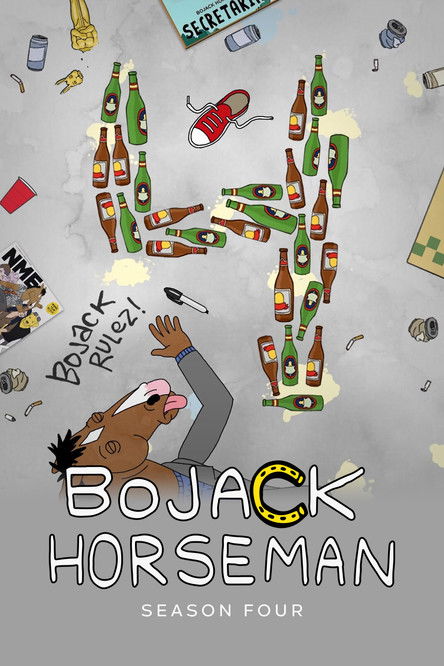
While BoJack wrestles with self-loathing and loss, Todd helps Mr. Peanutbutter run for governor of California and Diane gets a job at a hip blog.
Season Review
Categorical Breakdown
Mr. Peanutbutter's gubernatorial campaign is a prolonged satire on political celebrity and media 'fairness bias' that explicitly critiques American politics. Diane's work at a Buzzfeed-style blog focuses on systemic issues and privilege, including gun violence and systemic racism. The character arc of the main male protagonist is consistently defined by his unchecked privilege and the wreckage he leaves for others, especially women, reflecting a focus on intersectional power dynamics.
The season's core dramatic arc explores the 'poisonous legacy' of BoJack's ancestors, specifically the 'chauvinistic' and emotionally repressed culture of his white, affluent family in the 1940s and 1950s. The past and its institutions, particularly the family unit, are presented as the primary source of intergenerational trauma and mental illness, demonstrating hostility toward one's own cultural and familial heritage. BoJack physically destroys his childhood home, rejecting that past.
Diane's narrative centers on the double standards and sexism in media, arguing that women who stand up for themselves are 'slunts' while men are praised for doing the 'bare minimum'. Princess Carolyn's story heavily focuses on the intense struggle to 'have it all,' with her career ambitions conflicting with her desire for family, involving an emotionally difficult miscarriage storyline. Beatrice's backstory strongly frames the traditional wife/mother role as a prison of internalized misogyny and disappointment.
A main character, Todd Chavez, explicitly comes out as asexual, and this alternative sexual identity is explored, affirmed, and celebrated through new community-building and a new relationship. This plotline centers a non-traditional sexual identity. Hollyhock's background as a child with eight adoptive fathers deliberately deconstructs the nuclear family unit and presents a fluid family structure as a positive norm.
The show is explicitly described as having a 'nihilistic philosophy' in its approach to life. Morality is consistently subjective and non-transcendent, resting entirely on the individual's effort to be a 'good person' by simply 'not doing bad things' and taking accountability. The episode that tackles gun violence is titled 'Thoughts and Prayers,' which acts as a cynical and direct cultural critique of a phrase strongly associated with contemporary Christianity in American discourse.