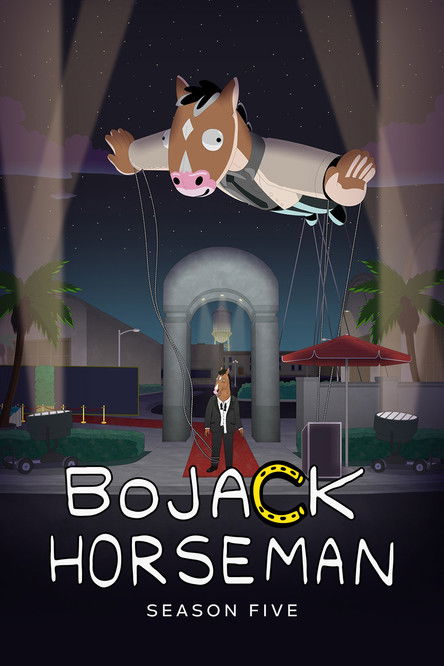
BoJack Horseman
Season 5 Analysis
Season Overview
BoJack's back on screen as the star of "Philbert," a new detective series produced by Princess Carolyn. But his demons are out in full force.
Season Review
Categorical Breakdown
The plot directly confronts privilege and systemic corruption in Hollywoo by centering an episode around BoJack becoming a publicly celebrated 'male feminist' for performing the bare minimum. It critiques the system's ease of forgiveness for toxic white males like BoJack and the fictional Vance Waggoner. Diane's arc explicitly focuses on her Vietnamese-American identity and feelings of diasporic alienation, relying on an intersectional lens for character development.
The central theme is a deep, cynical indictment of 'Hollywoo,' which serves as a metonym for corrupt, self-destructive American celebrity and media culture. The pervasive philosophical outlook remains one of nihilism, asserting that life is meaningless and that all human effort in this cultural context is ultimately futile and absurd. Ancestors are consistently portrayed as the source of personal trauma and dysfunction, reinforcing the idea of a fundamentally flawed societal inheritance.
The season is built around themes directly related to the #MeToo movement and the critique of 'toxic masculinity,' positioning BoJack as the avatar for the privileged, self-obsessed male protagonist. Female characters like Princess Carolyn and Diane are the primary moral and professional forces, with Princess Carolyn fully embodying the 'Girl Boss' archetype by single-mindedly pursuing a high-powered career and eventually single motherhood via adoption. Men are frequently depicted as morally bankrupt (BoJack), bumbling and shallow (Mr. Peanutbutter's attempt to 'toughen up'), or incompetent (Henry Fondle the sex robot CEO).
Alternative sexualities are a normalized and prominent feature of the main ensemble. Todd's asexuality, the 'A' in LGBTQIA+, is a continuous and major plotline that explores the unique challenges of asexual dating and identity, moving it from a minor joke to a central theme. A high-profile, recurring lesbian couple, Dr. Indira and Mary Beth, are introduced as wise, moral, and successful women of color who deliver crucial social commentary, centering alternative pairing as a source of stability.
The core philosophical framework is nihilism, asserting that life is a search for meaning in a 'Godless Universe.' Characters explicitly struggle with moral law, and the solution offered is self-determined, subjective moral responsibility rather than any transcendent truth, as articulated by the moral compass character, Diane. Traditional religious belief is absent from the lives of the main characters, who exclusively seek fulfillment through secular means like career, relationships, and self-help, creating a spiritual vacuum.