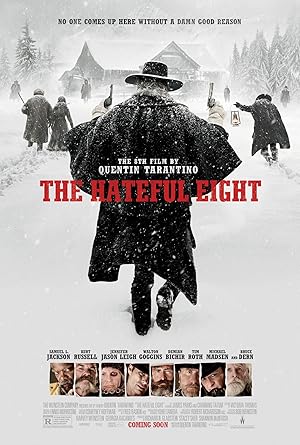
The Hateful Eight
Plot
Some time after the Civil War, a stagecoach hurtles through the wintry Wyoming landscape. Bounty hunter John Ruth and his fugitive captive Daisy Domergue race towards the town of Red Rock, where Ruth will bring Daisy to justice. Along the road, they encounter Major Marquis Warren (an infamous bounty hunter) and Chris Mannix (a man who claims to be Red Rock's new sheriff). Lost in a blizzard, the bunch seeks refuge at Minnie's Haberdashery. When they arrive they are greeted by unfamiliar faces: Bob, who claims to be taking care of the place while Minnie is gone; Oswaldo Mobray, the hangman of Red Rock; Joe Gage, a cow puncher; and confederate general Sanford Smithers. As the storm overtakes the mountainside, the eight travelers come to learn that they might not make it to Red Rock after all...
Get the Weekly Woke Watchlist
New and trending movies scored for woke bias, preachy messaging, and forced political themes — before you waste your evening.
No spam. One useful email per week.
Overall Series Review
Categorical Breakdown
The plot is entirely built upon the racial, regional, and political identity conflict between an ex-Union Black Major, an ex-Confederate General, and a Southern racist who claims to be a sheriff. The narrative focuses intensely on the post-Civil War struggle where racial slurs and historical grievances are used as weapons and tools for manipulation. Race is a primary factor determining alliance and suspicion, overshadowing individual merit. The Major uses a forged letter from Abraham Lincoln to establish trust with white men, showcasing a reliance on political identity to survive. The narrative heavily scrutinizes the historical power dynamics of whiteness, particularly Southern whiteness, but complicates the simple victim-oppressor dynamic by making the Black character equally ruthless and morally compromised.
The film's sole purpose is to portray post-Civil War America as a microcosm of irredeemable depravity, where every character is a hateful, greedy, and murderous criminal or nihilist. The violence is relentless, and there is an intentional lack of any clear moral imperative or 'salvation' in the American character. The film indicts the very foundations of American identity, suggesting its roots are soaked in blood, racism, and misogyny. This narrative directly rejects the concept of American Exceptionalism and portrays institutions of law, justice, and government as corrupt or impotent.
The single female character is a criminal outlaw who is relentlessly beaten, abused, and ultimately lynched by the men. She is portrayed as smart and manipulative but is physically subjugated throughout the film. Her end is not one of empowerment or a 'Girl Boss' victory; instead, her violent execution is interpreted by some analysis as a reinforcement of patriarchal dominance. The film's content is graphically brutal and anti-female-heroic, representing a complete rejection of contemporary 'Mary Sue' or 'Girl Boss' tropes.
The film contains no themes related to centering alternative sexualities, deconstructing the nuclear family, or lecturing on gender ideology. A shocking recounted story of sexual violence is used as a tool for racial revenge and psychological torture, but this scene does not advance any 'Queer Theory Lens.' The narrative remains focused on traditional male-female pairings and the brutality of the post-war American West.
A strong current of moral nihilism permeates the entire film, which portrays a universe where objective truth and a higher moral law are absent. Every character is morally despicable, sadistic, and driven by self-interest, greed, or vengeance. The themes of 'justice' and the 'better angels of our nature,' symbolized by a letter from Abraham Lincoln, are revealed to be cynical lies, reinforcing that morality is subjective and a tool of power dynamics. There is no presence of faith or traditional religion as a source of strength or hope, leaving a spiritual vacuum.
Get the Weekly Woke Watchlist
New and trending movies scored for woke bias, preachy messaging, and forced political themes — before you waste your evening.
No spam. One useful email per week.