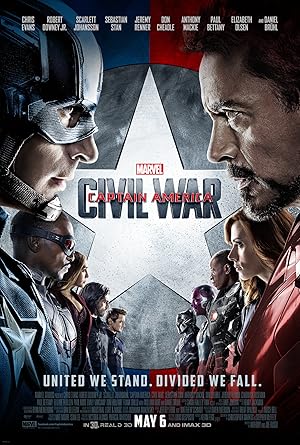
Captain America: Civil War
Plot
With many people fearing the actions of super heroes, the government decides to push for the Hero Registration Act, a law that limits a hero's actions. This results in a division in The Avengers. Iron Man stands with this Act, claiming that their actions must be kept in check otherwise cities will continue to be destroyed, but Captain America feels that saving the world is daring enough and that they cannot rely on the government to protect the world. This escalates into an all-out war between Team Iron Man (Iron Man, Black Panther, Vision, Black Widow, War Machine, and Spider-Man) and Team Captain America (Captain America, Bucky Barnes, Falcon, Scarlet Witch, Hawkeye, and Ant Man) while a new villain emerges.
Get the Weekly Woke Watchlist
New and trending movies scored for woke bias, preachy messaging, and forced political themes — before you waste your evening.
No spam. One useful email per week.
Overall Series Review
Categorical Breakdown
Characters are judged by their personal ethics and position on the Sokovia Accords, which promotes a universal meritocracy of principle. The narrative introduces Black Panther, a Black King from a highly advanced, un-colonized African nation, who is shown as highly competent and noble without lecturing on race or systemic oppression. The casting of Falcon and Black Panther is treated as a natural and powerful part of the ensemble, not as an engine for intersectional hierarchy.
The narrative's central conflict is driven by Captain America's deep-seated skepticism of government and institutions, believing that even noble organizations will inevitably become corrupted, as seen with S.H.I.E.L.D.'s past infiltration by Hydra. This represents a critique of the modern American security state, rather than a broad hatred of Western civilization or its ancestors. The advanced African nation of Wakanda is introduced and presented as superior in technology and governance, suggesting a mild preference for an 'Other' culture over a corruptible West.
Female characters like Black Widow, Scarlet Witch, and Sharon Carter are strong, powerful, and central to the action, but their development is linked to accountability and their own character flaws (Scarlet Witch's accidental civilian deaths drive the plot). The female characters are not depicted as flawless 'Mary Sues,' and the main male leads are competent and emotionally complex. There is no overt anti-natalist or anti-family messaging; the central tragedy is the fracturing of the heroes' surrogate family.
The movie does not feature any overt LGBTQ+ themes or characters. The narrative focuses on the political and personal conflict, adhering to a normative structure where traditional male-female pairings are implicitly the standard and sexuality is kept private and unaddressed.
The core moral debate is a philosophical and political one, dealing with power, oversight, and accountability, not explicitly with religion or theology. Captain America's stance is based on an objective moral truth and conscience, which aligns with transcendent morality, though it is not explicitly framed in a religious context. There is no hostility toward religion or vilification of religious characters.
Get the Weekly Woke Watchlist
New and trending movies scored for woke bias, preachy messaging, and forced political themes — before you waste your evening.
No spam. One useful email per week.