Thor: Ragnarok
Plot
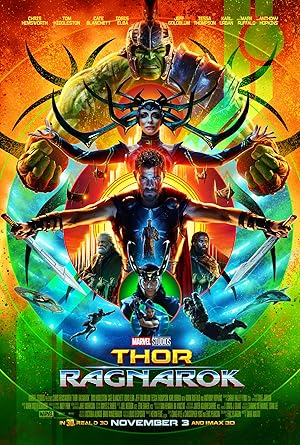
Imprisoned on the other side of the universe, the mighty Thor (Chris Hemsworth) finds himself in a deadly gladiatorial contest that puts him against The Incredible Hulk (Mark Ruffalo), his former ally and fellow Avenger. Thor's quest for survival leads him in a race against time to prevent the all-powerful Hela (Cate Blanchett) from destroying his home world and the Asgardian civilization.
Get the Weekly Woke Watchlist
New and trending movies scored for woke bias, preachy messaging, and forced political themes — before you waste your evening.
No spam. One useful email per week.
Overall Series Review
Categorical Breakdown
The character Valkyrie, a white, blonde figure in the source material, is re-cast with an actress of color, a decision noted by some as a conscious choice for diversity rather than narrative need. The film's primary plot reveals that the history of the Asgardian kingdom is 'whitewashed' and founded upon 'bloody warfare and conquest,' essentially framing the white-coded mythological home culture as a deeply corrupt, colonial enterprise.
The entire narrative is built on the deconstruction of Asgard's heritage, revealing King Odin to be a genocidal conqueror who covered up his past atrocities with pretty murals. Hela's return literally rips apart the cultural narrative to reveal the hidden history of violent expansion. The climax requires the complete, fiery destruction of the ancestral home to save the people, with the central lesson being that 'Asgard is a people, not a place.'
Two powerful female characters, the villain Hela and the anti-hero Valkyrie, dominate the story, both of whom are superior warriors to the male lead for much of the film. Hela’s motivation is rooted in her initial role as an instrument of male conquest whose power was feared and discarded by her father, Odin. Thor's male power is repeatedly undermined and ridiculed as he loses his legendary hammer, is subjected to a painful haircut, and is constantly outwitted or outmaneuvered by the female characters and his brother.
The character Valkyrie is canonically bisexual in the comics and was intended to be so in the Marvel Cinematic Universe, but there is no explicit scene or dialogue in this movie that addresses or centers on her sexuality. A small scene hinting at her past loss was cut, leaving the final film with no overt representation of alternative sexualities or gender theory messaging.
The Asgardian characters, often revered as Norse 'gods' in previous films, are consistently reduced to powerful, long-lived aliens. Hulk mocks Loki's claim to divinity by calling him a 'puny god.' The most divine figure, Odin, is exposed as a flawed, warmongering king whose reign ends in an ignoble death. The culture's divine home is ultimately sacrificed as a necessary evil, undermining any sense of transcendent or sacred power associated with their pantheon.
Get the Weekly Woke Watchlist
New and trending movies scored for woke bias, preachy messaging, and forced political themes — before you waste your evening.
No spam. One useful email per week.