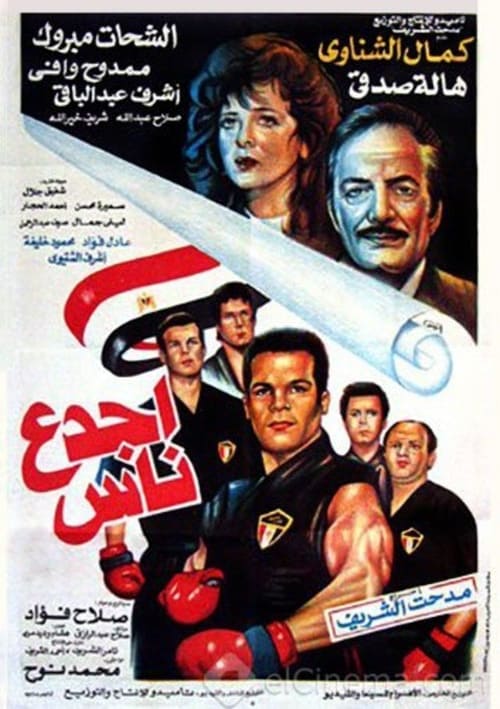
Agda' Nas
Plot
Rashwan, the coach of the Foul Contact game, persuades the head of the Supreme Council for Sports and Youth to revive the national team for that game to confront an American team, and the coach begins to assemble the five members of the team that was dissolved: Khaled Al-Shabrawi, who suffers from the control of his mother, the arrogant young Dasiti, and Abdel Hamid Safwan, who is fleeing an old revenge Adel Aziz Morcos, "who wishes to emigrate abroad, and Musa Abu Zaid, a former soldier in the Gulf War."
Get the Weekly Woke Watchlist
New and trending movies scored for woke bias, preachy messaging, and forced political themes — before you waste your evening.
No spam. One useful email per week.
Overall Series Review
Categorical Breakdown
Characters are defined by personal flaws, social problems, and regional background, but their worth is entirely determined by their athletic merit and commitment to the national team's goal. The team's diversity is a simple reflection of the nation (Christian, Sa'eedi, etc.) without any narrative focus on 'privilege' or systemic oppression. The conflict is national pride versus a foreign opponent, not intersectional hierarchy.
The central action involves the coach and team fighting to revive a national sport and defeat an American team, directly affirming the dignity and strength of the home nation (Egypt). One character who wishes to emigrate chooses to fight for his country's victory first, placing national honor above personal gain. The film operates as an expression of national gratitude and patriotism, the opposite of civilizational self-hatred.
The core plot is a masculine story focused on male striving, overcoming personal weakness, and physical excellence through sport. Masculinity is protective, exemplified by the character Musa Abu Zaid, a widower dedicating himself to his son’s happiness. The only explicit mention of a strong female presence is the mother who controls her adult son, which is framed as a problem he needs to overcome to assert his identity, not a 'Girl Boss' celebration.
The narrative adheres to a normative structure, centering on sports, national duty, and traditional family concerns like fatherhood and engagement to a fiancée. The story features a widower and father and a character with a fiancée, placing the traditional nuclear structure as the baseline. There is no presence of alternative sexual ideology or deconstruction of biological reality.
Moral conflicts center on traditional virtues like national loyalty, dedication, and overcoming personal flaws like arrogance or seeking revenge (Thaar). The presence of a Coptic Christian character on the national team, whose primary conflict is emigration versus national duty rather than his faith, suggests the acknowledgement of religion within a cohesive national moral framework. The film champions objective good (winning with honor) rather than moral relativism.
Get the Weekly Woke Watchlist
New and trending movies scored for woke bias, preachy messaging, and forced political themes — before you waste your evening.
No spam. One useful email per week.