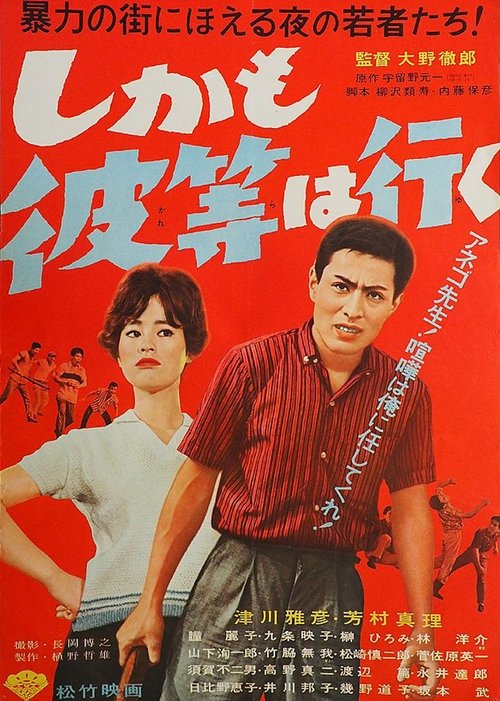
Shikamo karera wa iku
Plot
Film directed by Tetsuo Ôno
Get the Weekly Woke Watchlist
New and trending movies scored for woke bias, preachy messaging, and forced political themes — before you waste your evening.
No spam. One useful email per week.
Overall Series Review
Categorical Breakdown
The film is a Japanese production from 1960, meaning the cast is racially and culturally homogeneous, which is historically authentic and not a forced insertion of diversity. The narrative is centered on Japanese characters, and there is no concept of 'whiteness' to vilify, making the category's criteria irrelevant and forcing a score of 1. The focus is on universal human drama and merit within the societal context of the time, aligning with the universal meritocracy end of the scale.
As a film from a post-war, pre-radicalized Japan, the cultural attitude is one of national reconstruction and continuity. Institutions like the family and national identity are presented as integral to society. The theme of civilizational self-hatred is entirely absent. The narrative demonstrates an inherent respect for the culture, functioning as a Chesterton's Fence—viewing tradition and social order as a positive structure against chaos.
Gender dynamics reflect the traditional roles prevalent in 1960s Japanese society. While a brief synopsis mentions a female character who 'teaches English in part-time school', suggesting a working woman, this does not translate into the modern 'Girl Boss' or 'Mary Sue' trope. The film adheres to the traditional, complementary male and female roles of its time, presenting masculinity as protective and femininity (including motherhood, implicitly) as vital to the family unit, thus avoiding the anti-natalist or emasculating themes of modern feminism. A score of 2 acknowledges the presence of a working woman but firmly keeps it in the non-woke range.
The subject matter of alternative sexualities, the deconstruction of the nuclear family, or gender ideology is not a feature of mainstream 1960s Japanese cinema. The film naturally operates within a normative structure where the traditional male-female pairing is the societal and narrative standard. Sexuality remains private and is not centered as an overriding political or social identity.
Japanese cinema in 1960 focuses on human morality, social pressure, and universal ethics, not Western-style anti-theism (specifically directed at Christianity). While Shinto or Buddhist elements may be present, they are cultural backdrops rather than the target of hostility. Morality is derived from the established social order and character actions, reflecting a higher moral law or objective truth within the culture's context, not the subjective 'power dynamics' of moral relativism. A score of 2 is given as the moral framework is likely traditional and not overtly spiritual, but also not hostile.
Get the Weekly Woke Watchlist
New and trending movies scored for woke bias, preachy messaging, and forced political themes — before you waste your evening.
No spam. One useful email per week.