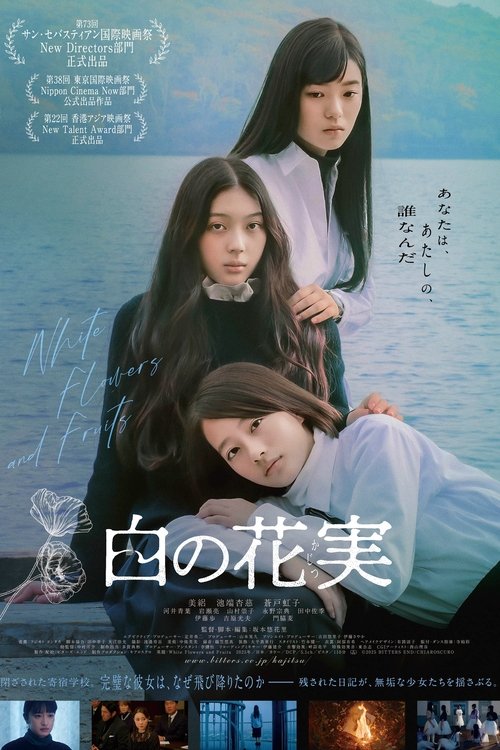
White Flowers and Fruits
Plot
Set in an all-girls Christian boarding school, Anna always feels like an outsider due to her ability to see ghosts. Her roommate, Rika, is the complete opposite: an effortlessly popular, well-liked honors student admired by everyone. But when Rika takes her own life, the entire school is shaken, none more so than her closest friend, Shiori, who struggles to make sense of the loss. After discovering Rika’s diary, Anna begins to feel her spirit manifest before her, slowly seeping into her body…
Get the Weekly Woke Watchlist
New and trending movies scored for woke bias, preachy messaging, and forced political themes — before you waste your evening.
No spam. One useful email per week.
Overall Series Review
Categorical Breakdown
The story is a Japanese production focused on a universal J-horror and psychological drama involving all-Japanese characters. The conflict centers on a ghost, grief, and emotional outsider status, with no reliance on an intersectional hierarchy, racial vilification, or forced diversity. Character merit and psychological state are the primary drivers of the plot.
As a Japanese film, the narrative does not engage in hostility toward Western civilization, ancestors, or home culture. Criticism is limited to the local setting of the boarding school's 'stiff authority figures' and 'clueless parents,' which is a universal trope in coming-of-age media, not civilizational self-hatred.
The setting is an all-girls school, which naturally centers female characters and limits the presence of men, who 'hardly figure.' The main character, Anna, is an 'outsider' and 'problem child,' which contradicts the 'perfect instant Mary Sue' trope. The plot explores intense female relationships and turbulence, but does not explicitly push anti-natalist messaging or 'Girl Boss' celebration; rather, it highlights vulnerability and tragedy.
The narrative focuses on intense female friendships, grief, and a supernatural manifestation. There is no explicit centering of alternative sexualities, no lecturing on gender theory, and no deconstruction of the nuclear family within the main plot. Sexuality is private and largely absent, keeping the structure normative.
The setting is a Protestant Christian boarding school, a major source of atmosphere and institutional structure. The institution is shown to be incapable of dealing with the suicide and the supernatural phenomena. This suggests a critique of the institution's effectiveness in preventing tragedy, but there is no overt demonization of faith or promotion of moral relativism as the basis of the plot.
Get the Weekly Woke Watchlist
New and trending movies scored for woke bias, preachy messaging, and forced political themes — before you waste your evening.
No spam. One useful email per week.