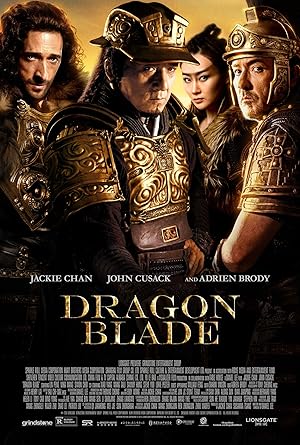
Dragon Blade
Plot
When corrupt Roman leader Tiberius arrives with a giant army to claim the Silk Road, Huo An and his group of trained warriors teams up with an elite legion of defected Roman soldiers led by General Lucius to maintain the delicate balance of power in the region. To protect his country and his new friends, Huo An gathers the warriors of thirty-six ethnic nations together to fight Tiberius in an incredible epic battle.
Get the Weekly Woke Watchlist
New and trending movies scored for woke bias, preachy messaging, and forced political themes — before you waste your evening.
No spam. One useful email per week.
Overall Series Review
Categorical Breakdown
The narrative's central theme is unity and harmony among the 'thirty-six ethnic nations' of the Silk Road and the Chinese and Roman peoples, making identity a constant factor. The Chinese hero, Huo An, is explicitly positioned as a moral teacher, a pacifist who is 'trained to keep peace,' while the Roman hero, Lucius, is initially portrayed as an aggressive foreigner who is 'trained to kill.' This suggests a moral superiority on the part of the Eastern character based on his national philosophy. The core villain, Tiberius, is a corrupt white Roman male representing tyranny, who is eventually defeated by the combined forces of the diverse group. The ultimate message is universal, but it relies on an explicit ethnic hierarchy to set up the conflict before resolution, preventing a 1/10 score.
The conflict is not between a virtuous foreign culture and a fundamentally flawed home culture. The main villain, Tiberius, represents a corrupt elite and imperial tyranny within the Roman system, and the Roman hero, Lucius, is a noble defector fleeing that corruption. The Chinese hero, Huo An, is also betrayed and exiled by corruption within his own government. This portrays institutional corruption and the universal struggle of honorable men against wickedness, not wholesale civilizational self-hatred for either the West or the East. A focus on unity across cultures, rather than deconstruction of the home culture, keeps the score low.
The main female characters fit traditional or complementary roles. Huo An's wife, Xiu Qing, is portrayed as 'saintly' and Huo An is a 'family man' who mourns her death. Another female character, Lady Cold Moon, is a strong warrior and leader of the Xiongnu tribe, but her arc includes romantic pursuit of the male protagonist. There is no noticeable presence of the 'Girl Boss' trope, the emasculation of male characters, or messaging hostile to the nuclear family or motherhood, keeping the gender dynamics traditional and complimentary.
The movie is a historical action epic focused on military and political conflict between nations and individuals. The search results and plot summaries contain no discernible references to LGBTQ+ themes, non-traditional sexuality, or the promotion of gender ideology. The standard structure of traditional male-female pairing is maintained.
The narrative's focus is on honor, loyalty, brotherhood, and geopolitical peace, rather than spirituality or religion. There is no commentary, dialogue, or plot device dedicated to vilifying or attacking traditional religion, specifically Christianity or Chinese beliefs. The morality is framed as transcendent honor and universal justice, not subjective moral relativism, resulting in a low score.
Get the Weekly Woke Watchlist
New and trending movies scored for woke bias, preachy messaging, and forced political themes — before you waste your evening.
No spam. One useful email per week.