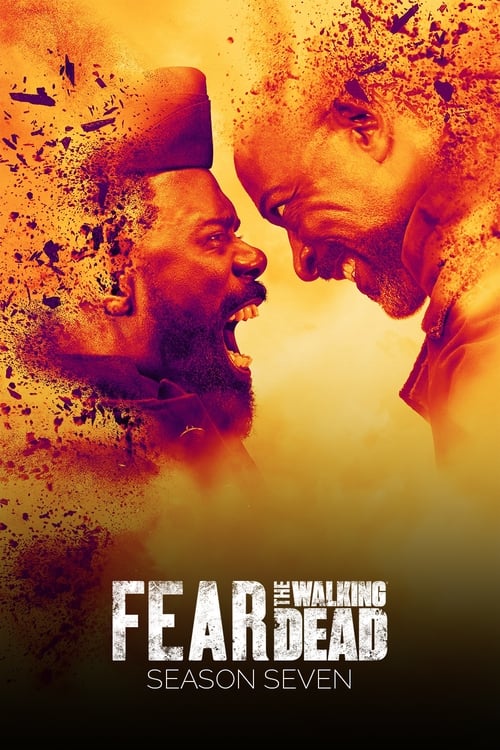
Fear the Walking Dead
Season 7 Analysis
Season Overview
Teddy brought about his vision of "The End" when he detonated nuclear warheads across the Texas landscape, but it will be up to those who survived to decide what "The Beginning" will look like. And they'll have to do it in a world devoid of light and hope, where the outside air is just as deadly as the walkers they face. The survivors will find out who they really are and what they're really made of. Some will rise to the occasion, some will find new purpose, and some will redefine themselves -- even if it comes at a terrible cost to those they once considered family.
Season Review
Categorical Breakdown
The core conflict is between two Black male characters, Morgan (protagonist) and Victor Strand (antagonist), which decentralizes 'whiteness' as a narrative focus for good or evil. The cast is intentionally diverse, including Latinx and Black characters in prominent roles. However, the conflict is philosophical and moral, not explicitly framed through an intersectional lens or centered on lecturing about privilege.
The narrative does not demonize historical Western civilization or ancestors. Victor Strand, the main antagonist, attempts to create a new, elitist 'civilization' in his Tower, but this is presented as a flawed, selfish institution born of the apocalypse, not a critique of pre-apocalypse culture. The heroes are working toward rebuilding a safe, stable community (PADRE), indicating a respect for new institutional structures that provide safety.
Female characters like Alicia and the returning Madison are central, serving as strong leaders and driving forces. Grace's arc involves a refusal to embrace motherhood after losing her child, only to be forced to care for another, and she is written as emotionally unstable and selfish by some interpretations of the storyline. This framing, which arguably critiques the idea of motherhood as a prison, elevates the score. Male characters are not broadly emasculated, as the main protagonists and antagonists, Morgan and Strand, are men with strong, albeit conflicting, agency.
Victor Strand is an openly gay male who is the season's primary, long-running antagonist. This normalizes an alternative sexuality but also attaches it to the most morally corrupt character, preventing a maximum score for centering it as a purely superior trait. His sexuality is an established fact, not the focus of a didactic lecture or his primary character driver. The focus on the nuclear family is absent, but this is a natural consequence of the long-running apocalypse, not an ideological deconstruction.
The conflict stems from a secular, nihilistic cult leader, Teddy, whose ideology is 'The End is the Beginning,' rather than a critique of traditional religion. The show's moral framework is defined by the human struggle between Morgan's selflessness and Strand's self-interest, acknowledging an objective good and evil without invoking or vilifying traditional Christian faith.