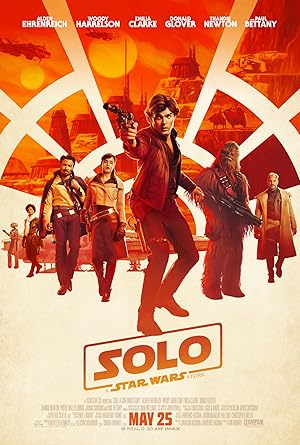
Solo: A Star Wars Story
Plot
With the emerging demand of hyperfuel and other resources, Han Solo finds himself in the middle of a heist alongside other criminals, where they meet the likes of Chewbacca and Lando Calrissian in an adventurous situation exposing the criminal underworld.
Get the Weekly Woke Watchlist
New and trending movies scored for woke bias, preachy messaging, and forced political themes — before you waste your evening.
No spam. One useful email per week.
Overall Series Review
Categorical Breakdown
The film features a diverse supporting cast of competent women and minorities surrounding the white male lead. The protagonist, Han Solo, is the moral anchor and eventual hero of the story. The narrative avoids relying on intersectional hierarchy, choosing instead to focus on individualist themes and anti-authoritarianism, but the concentration of diverse, hyper-competent allies around the main hero elevates the score slightly.
The system being criticized is the overtly totalitarian Galactic Empire, which is canonically antithetical to concepts of liberty and family. The film focuses on criminal syndicates, not a metaphor for Western civilization or its ancestors. The core lesson centers on loyalty and individual freedom against tyranny and corruption, aligning with traditional Western values of liberty.
The female leads, Qi'ra and Val, are highly competent and capable in their criminal roles. The score is significantly impacted by the presence of the droid L3-37, who is overtly a 'woke droid committed to social justice' and a militant activist for droid emancipation, a theme explicitly played for both social commentary and humor. Her character acts as a direct, explicit vessel for progressive gender/identity politics.
The film contains no explicit on-screen LGBT relationship or gender deconstruction within the human characters. However, a screenwriter confirmed in promotion that the character Lando Calrissian is pansexual, partially in reference to his relationship with the droid L3-37. This external centering of sexual ideology about an iconic character, coupled with the intimate man-droid relationship being the closest approximation of the theme, warrants a mid-range score for ideological intent, even with low on-screen centering.
The spiritual dimension of the film is largely absent, focusing instead on a secular criminal underworld. The primary moral conflict is a matter of personal choice and loyalty (Han's innate 'good guy' nature) against cynicism and greed. There is no depiction or critique of traditional religion or objective morality being framed as evil or oppressive.
Get the Weekly Woke Watchlist
New and trending movies scored for woke bias, preachy messaging, and forced political themes — before you waste your evening.
No spam. One useful email per week.