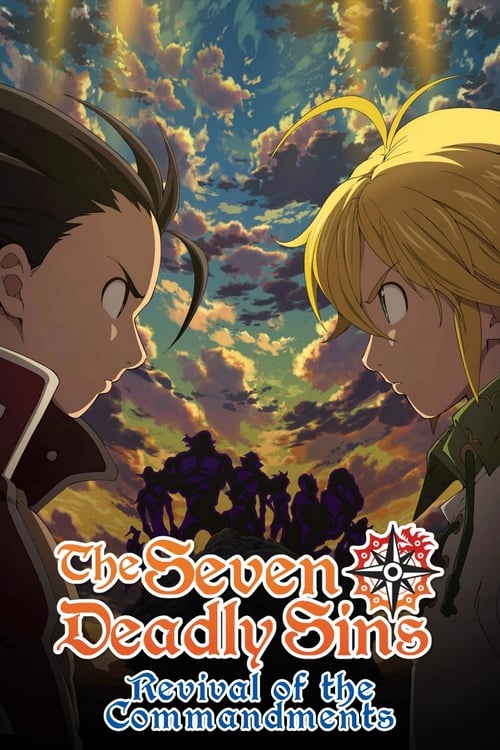
The Seven Deadly Sins
Season 2 Analysis
Season Overview
As peace returns to the Kingdom of Liones, the Sins decide to pursue separate paths to continue their own individual journeys. Gowther brainwashes Guila into falling in love with him, while Diane spends time as a normal human thanks to Merlin’s Minimum Tablets, which allow her to shrink in size. Diane also slowly regains her past memories, which include her prior encounters with King, and reunites with Matrona, her mother figure, and the giant race. Meanwhile, Ban departs for the Fairy King’s Forest with King and the Holy Knight Jericho to continue his duties as he is revealed to be the current Fairy King. Back in Liones, King Bartra’s Vision ability shows him an omen of the impending dangerous Holy War that lies ahead in Camelot.
Season Review
Categorical Breakdown
Characters are judged by their power, skill, and moral conviction, aligning with Universal Meritocracy. The world's races (Giants, Fairies, Humans) are fantasy constructs and are not used as stand-ins to lecture on real-world race or intersectional hierarchy.
The conflict centers on an external threat (The Ten Commandments/Demon Clan) and the purging of internal corruption within the existing Kingdom of Liones, not the demonization of the home culture or ancestral institutions. King Bartra's vision is a transcendent protective measure for the nation.
Female characters are extremely powerful (Merlin, Diane) and capable, preventing a 1-score, but the narrative does not meet the 'Girl Boss' 10/10 criteria. Instead, it features pervasive, non-stop sexualization and objectification of the female characters by the male lead, which is antithetical to the 'Mary Sue' trope. The plot celebrates motherhood and familial bonds through Matrona and Diane's arc, aligning with Complementarianism.
The core relationships being established (King/Diane, Ban/Elaine) are traditional male-female pairings and the nuclear family model. Gowther's gender-ambiguous presentation is not a platform for lecturing on sexual identity or gender ideology; his main conflict involves finding a heart and understanding human emotion, and his manipulative actions are framed as morally wrong.
The entire series is structured around the concept of the Seven Deadly Sins, acknowledging an objective moral law and the need for personal redemption. The primary conflict is mythological (Demon vs. Goddess Clan), not an attack on real-world traditional religion, and a character's divine-like 'Vision' is treated as an objective truth.