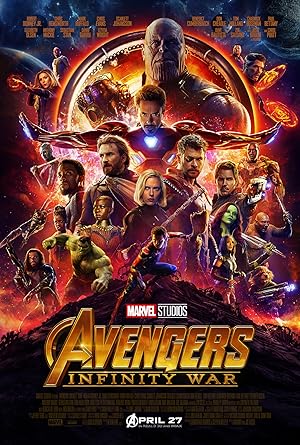
Avengers: Infinity War
Plot
As the Avengers and their allies have continued to protect the world from threats too large for any one hero to handle, a new danger has emerged from the cosmic shadows: Thanos. A despot of intergalactic infamy, his goal is to collect all six Infinity Stones, artifacts of unimaginable power, and use them to inflict his twisted will on all of reality. Everything the Avengers have fought for has led up to this moment, the fate of Earth and existence has never been more uncertain.
Get the Weekly Woke Watchlist
New and trending movies scored for woke bias, preachy messaging, and forced political themes — before you waste your evening.
No spam. One useful email per week.
Overall Series Review
Categorical Breakdown
The film centers on the merit-based, universal goal of saving the universe. Heroes of all races and genders are judged on their ability to contribute to the fight, exemplified by the central roles of Wakandan characters and the diverse Guardians of the Galaxy. The main antagonist is an alien titan with a Malthusian ideology, not a stand-in for 'whiteness' or systemic oppression.
The film is fundamentally a defense of 'home'—Earth and all other planets—against a chaotic, genocidal force. Western civilization (represented by the classic American heroes) and non-Western cultures (like Wakanda and the Guardians' various worlds) are all portrayed as fundamentally worth saving. There is no narrative component that criticizes or demonizes Western heritage or ancestors; the threat is purely external.
Female characters like Gamora, Nebula, Black Widow, Scarlet Witch, and Okoye are depicted as highly competent, fierce warriors who are crucial to the plot and various battle sequences. The inclusion of strong women is natural to the established characters and their history, emphasizing competence over a 'Mary Sue' trope. The narrative does not contain anti-natalist or anti-family messaging, though the primary conflict supersedes domestic life.
There is no explicit centering of alternative sexualities or gender ideology. The film contains no on-screen LGBTQ+ characters or storylines. The focus remains strictly on the epic, universe-level conflict and the established heterosexual romantic subplots for characters like Vision/Scarlet Witch and Star-Lord/Gamora.
The core conflict revolves around Thanos’s morally relative and deeply flawed philosophical zealotry ('mercy' through genocide) being opposed by the heroes, who fight for the objective truth of the right to life. The film features characters considered 'Gods' (Thor, Loki), but they are treated within the MCU's canon as powerful alien beings, not as a direct attack on traditional religion. The themes of sacrifice and redemption align more closely with transcendent morality than with anti-theism.
Get the Weekly Woke Watchlist
New and trending movies scored for woke bias, preachy messaging, and forced political themes — before you waste your evening.
No spam. One useful email per week.