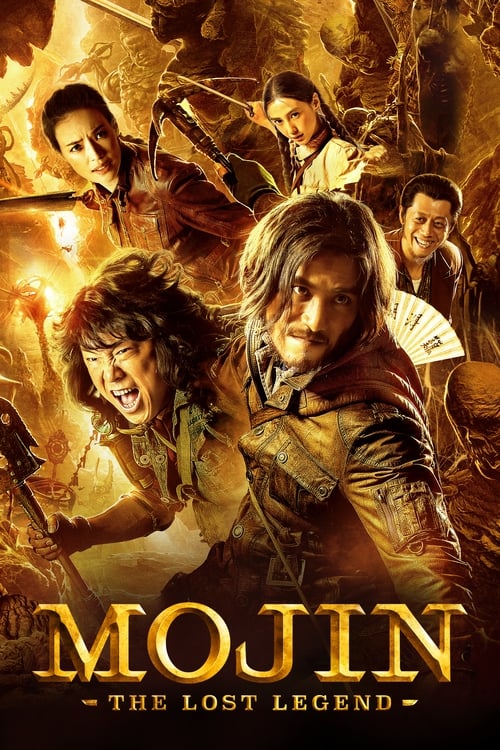
Mojin: The Lost Legend
Plot
Three tomb raiders retire from their roles and move to New York to enjoy the rest of their lives. However, they are asked to resume duty in order to find out the reason behind the loss of a loved one.
Get the Weekly Woke Watchlist
New and trending movies scored for woke bias, preachy messaging, and forced political themes — before you waste your evening.
No spam. One useful email per week.
Overall Series Review
Categorical Breakdown
The story is a Chinese production featuring a Chinese cast and story about Chinese tomb raiders. The characters are defined by their unique skills and personal loyalties, not by race or intersectional hierarchy. The primary villains are a wealthy Chinese businesswoman/cult leader and a 'nefarious multinational mining company' rather than 'whiteness' or Western power, though there are minor international henchmen.
The film explicitly frames a 'sick America' in its opening, contrasting the characters' unsuccessful life in New York with a yearning for their past in China. The flashback sequences show the protagonists as enthusiastic Red Guards in their youth who willingly destroy ancient Chinese statues as 'bourgeois excess,' an act of civilizational deconstruction that triggers the central supernatural conflict. The narrative is described as having a 'strong humanist, anti-capitalist worldview that’s pro-communist' with the heroes' past positively tied to the revolutionary era.
The female lead, Shirley Yang, is a key member of the tomb-raiding trio with her own 'Mojin credentials,' but her character is significantly reduced to expressing jealousy and emotional insecurity over the male protagonist’s lingering feelings for his lost first love. The main antagonist is a female 'mysterious businesswoman/cult leader,' which aligns with the 'Girl Boss' villain trope. The film avoids anti-natalism messaging and the primary love story remains traditional.
The narrative is structured around a traditional heterosexual love triangle and the standard nuclear pairing of the main male and female leads, who are fiances. There are no openly non-normative sexual identities or gender ideology themes present in the story, keeping the focus entirely on traditional pairing and sexuality being a private matter within the romantic subplots.
The worldview is described as 'strong humanist' where characters rely on their own skills and 'luck' to navigate the supernatural threats. The main conflict involves a wealthy cult seeking a mystical artifact that grants physical life-reviving power, representing a materialist and subjective spiritual quest rather than a transcendent one. Traditional religion is not overtly demonized, but the structure dismisses objective moral law in favor of a purely human-driven framework for action and belief.
Get the Weekly Woke Watchlist
New and trending movies scored for woke bias, preachy messaging, and forced political themes — before you waste your evening.
No spam. One useful email per week.