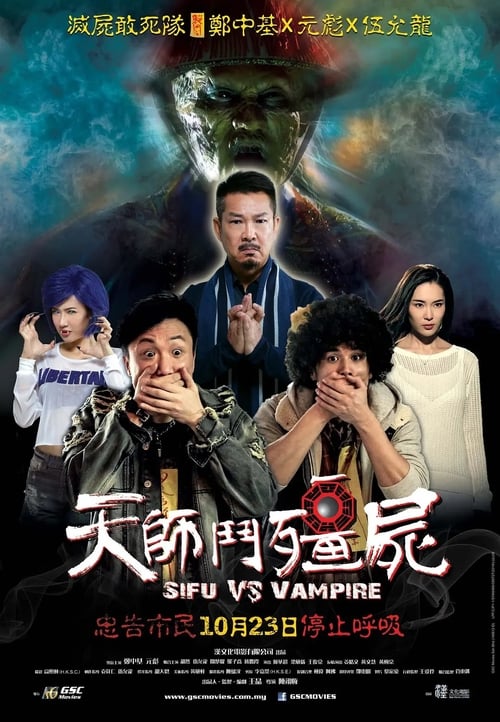
Sifu vs. Vampire
Plot
It is said that a corpse should be exhumed and moved every 30 years to ensure continued fortune and prosperity for its descendants. As the time limit is nearing for his grandfather's corpse, TV station boss Kelvin Chow (Kelvin Kwan, Tales from the Dark 2) looks to Charlie Jiang (Yuen Biao), whose ancestors performed the ritual for the Chow family, to complete the task. When Jiang refuses, citing his belief that the ritual is unethical, Chow enlists Nicky and Boo to coerce him into it. However, a series of accidents causes the corpse to be delivered to and left at Chow's TV station, unleashing a bloodbath.
Get the Weekly Woke Watchlist
New and trending movies scored for woke bias, preachy messaging, and forced political themes — before you waste your evening.
No spam. One useful email per week.
Overall Series Review
Categorical Breakdown
The film is an authentic production set entirely within the cultural and ethnic context of Hong Kong, focused on Chinese folklore. The cast is entirely Asian, and the narrative does not contain any vilification of 'whiteness,' forced diversity, or discussions of race-based privilege. Character merit is judged by their moral standing and their skill in Taoist practice and martial arts.
The narrative uses Taoist beliefs and the Feng Shui burial ritual as its core premise, portraying the Taoist Master as the ethical and capable protector of traditional wisdom, who refuses the ritual on principle. The moral villain is the greedy, modern TV boss who disrespects this heritage for financial gain. The film presents the Taoist tradition and ancestral respect as necessary institutions against chaos.
The movie is saturated with puerile, sex-obsessed humor, including jokes about 'large knockers' and 'blow jobs,' which is the opposite of anti-natalist or 'Girl Boss' messaging. Women are often objectified and presented as sexual targets for the male characters. One female character is a tough and capable martial arts disciple who handles a majority of the action, but this does not override the film's pervasive sexualization and juvenile male focus.
The narrative's structure is firmly normative, centering on traditional male-female pairings and the hero advising against a relationship with a ghost because it is 'unnatural'. The only element relating to alternative sexuality is a single gag where a male character is robbed by a 'transvestite,' which is used as a punchline and not an affirmation of 'Queer Theory' or sexual ideology.
The main hero, Charlie Jiang, is an ethical and highly respected Taoist Master who uses traditional Taoist magic, Feng Shui, and talismans as the only way to combat the supernatural evil. The film celebrates faith and traditional spiritual practice as the source of strength and objective moral order. The villain is an amoral *practitioner* of Taoism, not the faith itself.
Get the Weekly Woke Watchlist
New and trending movies scored for woke bias, preachy messaging, and forced political themes — before you waste your evening.
No spam. One useful email per week.