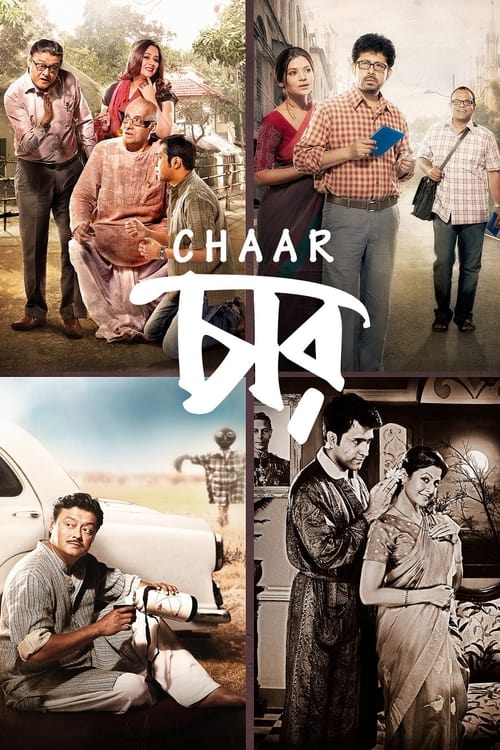
Chaar
Plot
Chaar is a Bengali anthology film based on four short stories by different writers: "Bateswarer Abodan" by Parasuram, "Porikkha" by Sharadindu Bandyopadhyay, "Kagtarua" by Satyajit Ray and "Dui Bondhu" by Satyajit Ray.
Get the Weekly Woke Watchlist
New and trending movies scored for woke bias, preachy messaging, and forced political themes — before you waste your evening.
No spam. One useful email per week.
Overall Series Review
Categorical Breakdown
The film’s closest connection to systemic critique appears in the story 'Kagtarua,' which deals with a wealthy singer's ruthless mistreatment and wrongful accusation of his poor, loyal servant. This highlights a classic class and power disparity, judging characters based on individual moral failure and merit (the servant's honesty) rather than a modern intersectional hierarchy based on race or immutable characteristics.
The movie demonstrates gratitude for its cultural roots by faithfully adapting classic stories from foundational Bengali authors, with settings and characters entirely within the traditional Bengali cultural sphere. Institutions of art, friendship, and family are treated with respect, and there is no evidence of hostility toward the home culture or ancestral heritage.
The gender dynamics are traditional and non-political. One story centers on a couple about to marry, implying a focus on the nuclear family. Female characters, such as the fictional and real Aloka, and the actress, are present, but the narrative provides no indication of 'Girl Boss' tropes, the emasculation of males, or anti-natalist messaging. Men and women are presented within conventional roles or grappling with universal professional and personal dilemmas.
The narrative adheres to a normative structure, with the main relationships being a traditional male-female romance and male-male friendship. There is no presence or intensity of alternative sexual ideology, deconstruction of the nuclear family, or lecturing on gender theory within the plot summaries.
The stories engage with objective moral law (the singer's guilt in 'Kagtarua') and even feature a supernatural or ghostly element, which acknowledges a reality beyond the purely material. The film shows no hostility toward traditional religion, and morality is not presented as subjective 'power dynamics.'
Get the Weekly Woke Watchlist
New and trending movies scored for woke bias, preachy messaging, and forced political themes — before you waste your evening.
No spam. One useful email per week.