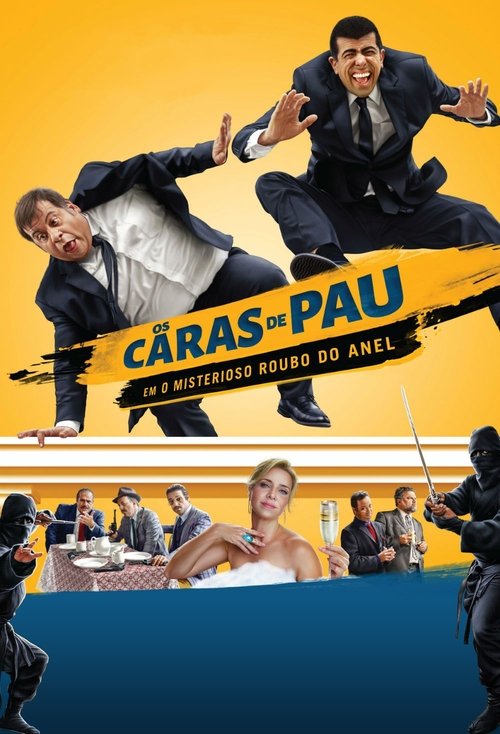
Os Caras de Pau em O Misterioso Roubo do Anel
Plot
The Tatu Tatuado de Topázio ring, by socialite Gracinha de Medeiros, is on display at a museum. She then hires the clumsy security guards Pedrão and Jorginho to watch over the jewel, a family heirloom. The ring is stolen and the pair accused of theft. To prove that they are innocent, they will have to face Portuguese mobsters and a gang of ninjas.
Get the Weekly Woke Watchlist
New and trending movies scored for woke bias, preachy messaging, and forced political themes — before you waste your evening.
No spam. One useful email per week.
Overall Series Review
Categorical Breakdown
The plot's premise centers on two white/non-racialized male characters who are incompetent, which is a comedic trope, not an ideological vilification of whiteness. Character merit is judged by the content of their soul, as they attempt to prove their innocence. Casting appears colorblind in the traditional sense, though the humor uses classic caricatures of Portuguese people and ninjas, which is a form of identity-based humor but is not based on the intersectional lens.
The central conflict revolves around protecting a valuable Brazilian family heirloom and is set in the home country, Rio de Janeiro. Institutions like the family (heirloom) and the museum are respected as shields that require protection. Humor directed at 'Portuguese mobsters' is an ethnic caricature specific to Brazilian comedy and does not constitute civilizational self-hatred or deconstruction of Western heritage.
The main characters are bumbling male idiots, a classic comedic device, which provides a mild form of emasculation. The female socialite, Gracinha de Medeiros, is the wealthy owner of the ring and the object of Pedrão's affection, giving her relative status in the plot's initial setup. There is no evidence of a 'Girl Boss' perfection narrative or anti-natalist messaging.
The humor includes 'jokes about gays' and puns with the word 'anel' (ring), suggesting the presence of humor directed at gay people or relying on traditional stereotypes and double entendre. This positions the film in opposition to the 'Queer Theory Lens' by using alternative sexualities as a subject of caricature rather than centering them or deconstructing the nuclear family as oppressive. The structure is normative by default.
One of the lead actors performs a known comedic type of the 'scandalous evangelical.' This indicates satire or caricature directed at a form of organized religion (Christianity). This is a partial de-sanctification of faith, but it is a humorous caricature of a specific religious subset rather than framing traditional religion as the fundamental root of evil or embracing moral relativism as a core theme.
Get the Weekly Woke Watchlist
New and trending movies scored for woke bias, preachy messaging, and forced political themes — before you waste your evening.
No spam. One useful email per week.