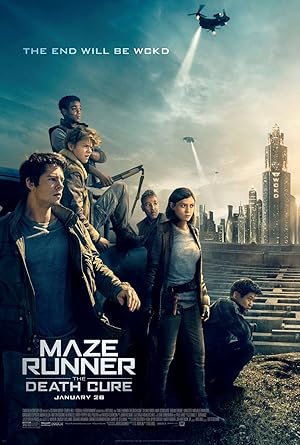
Maze Runner: The Death Cure
Plot
In the epic finale to The Maze Runner Saga, Thomas leads his group of escaped Gladers on their final and most dangerous mission yet. To save their friends, they must break into the legendary last city, a WCKD controlled labyrinth that may turn out to be the deadliest maze of all. Anyone who makes it out alive will get the answers to the questions the Gladers have been asking since they first arrived in the maze. Will Thomas and the crew make it out alive? Or will Ava Paige get her way?
Get the Weekly Woke Watchlist
New and trending movies scored for woke bias, preachy messaging, and forced political themes — before you waste your evening.
No spam. One useful email per week.
Overall Series Review
Categorical Breakdown
The core group of Gladers is visibly diverse, and leadership roles are assigned based on competence and bravery, not race or any intersectional hierarchy. The main conflict is a universal moral fight against a dystopian, scientific-authoritarian body. The protagonist, Thomas, is judged solely by the content of his character and his persistent moral drive. Race and immutable characteristics are simply not factors in the plot or character motivations.
The institutions being fought against—WCKD and the Last City—represent a corrupt, post-apocalyptic remnant of 'civilization' that relies on child experimentation to survive. The narrative condemns this specific authoritarian structure. This is a rejection of a dystopian system, but it does not generalize to a hatred of Western civilization, ancestors, or heritage. The heroes seek a new, uncorrupted 'home,' not a deconstruction of a historical one.
Female characters hold significant power; the primary antagonist, Ava Paige, is the head of the powerful WCKD organization. Teresa acts as a highly intelligent scientist and morally complex figure working to create the cure. Brenda is a capable and active member of the resistance. Men are not uniformly depicted as toxic or incompetent; Thomas, Minho, and Newt are competent, loyal, and central figures. The dynamic is generally complementary, though some female roles are framed around a love-interest subplot.
Sexual identity or gender ideology is not a component of the film's plot or themes. The narrative maintains a normative structure, focusing on the life-or-death struggle for survival and moral truth. There is no deconstruction of the nuclear family and no lecturing on alternative sexualities or gender theory.
The movie's moral framework revolves around a secular, humanist debate about the ethics of human experimentation for the greater good. The villains (WCKD) are not motivated by religious zealotry but by a cold, utilitarian scientific dogma. Faith, religion, or specific anti-Christian tropes are not present in the narrative. The story implicitly champions an objective, transcendent moral law by asserting that torturing children is fundamentally wrong, regardless of the stakes.
Get the Weekly Woke Watchlist
New and trending movies scored for woke bias, preachy messaging, and forced political themes — before you waste your evening.
No spam. One useful email per week.