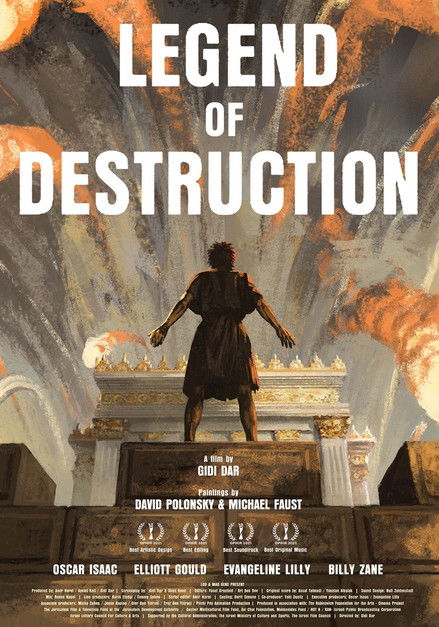
Legend of Destruction
Plot
What had initially started out as a Jewish revolt against the Roman occupation, quickly turned into a fierce civil war. The combination of religious messianic zeal and the friction between social classes proved disastrous and resulted in the destruction of Jerusalem and the Holy Temple.
Get the Weekly Woke Watchlist
New and trending movies scored for woke bias, preachy messaging, and forced political themes — before you waste your evening.
No spam. One useful email per week.
Overall Series Review
Categorical Breakdown
The narrative focuses on the conflict between Jewish groups driven by class differences, political schisms, and theological extremism rather than race or immutable characteristics. The destruction is a result of character failures like greed, corruption, and fanaticism, keeping the focus on universal moral vices over an intersectional power hierarchy.
The film’s central premise is that the destruction of the city and its most sacred institution, the Temple, was caused by the Jewish people’s own internal flaws, specifically 'needless hate' (Sinat Chinam), social injustice, and polarization. This frames the home culture and its ancestral institutions as fundamentally corrupt to the point of self-destruction, which is presented as a moral warning to descendants.
Queen Berenice is depicted as a 'cunning' and capable political figure who works desperately to protect the Holy Temple, while the dominant male factions (rebels and priests) are the source of the destructive civil war. This portrays a female character in a position of authority and foresight whose competence contrasts sharply with the male incompetence and toxicity that precipitates the disaster.
The plot is entirely focused on the historical, political, and religious conflicts of the First Jewish–Roman War in the first century. There are no elements related to alternative sexual identities, queer theory, or gender ideology lecturing present in the narrative.
The movie attributes the civil war and the ultimate destruction to 'religious fanaticism in the name of God' and 'religious extremism.' The zealous and corrupt religious figures are portrayed as the primary villains who bring about the catastrophe, directly supporting the interpretation that fundamental religious belief and its extreme application were the root cause of the society's ruin.
Get the Weekly Woke Watchlist
New and trending movies scored for woke bias, preachy messaging, and forced political themes — before you waste your evening.
No spam. One useful email per week.