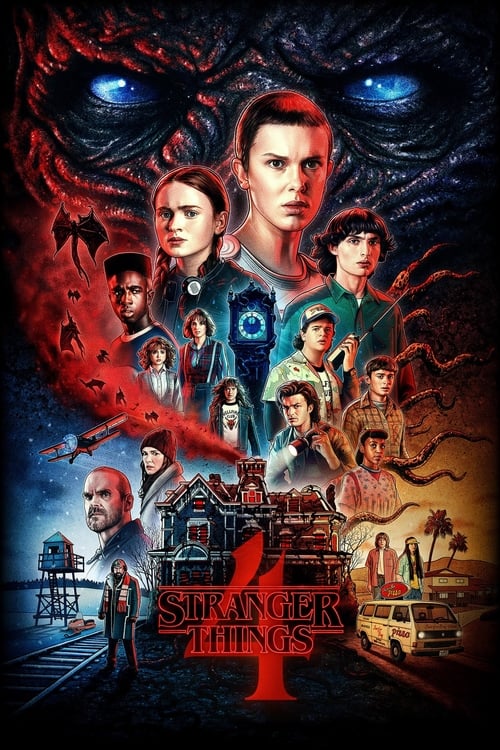
Stranger Things
Season 4 Analysis
Season Overview
Darkness returns to Hawkins just in time for spring break, igniting fresh terror, disturbing memories — and an ominous new threat.
Season Review
Categorical Breakdown
Characters are primarily judged by their courage and merit in the face of supernatural threats, which aligns with universal themes. The narrative does not elevate one race or immutable characteristic over others to lecture on systemic oppression, but it does heavily focus on the plight of the marginalized ‘outcast’ group against the ‘normal’ populace, a lens that easily maps onto intersectional discourse. A brief dialogue exchange between two main characters touches on a discussion of socioeconomic and gender privilege.
The town of Hawkins is depicted as a source of great danger not just from the monsters, but from its own people. The narrative portrays the community's traditional, conservative fear as dangerous and easily weaponized against innocent teenagers by an antagonist. The fear-driven 'Satanic Panic' leads the community to unjustly persecute the Hellfire Club. This frames the established home culture as paranoid, irrational, and fundamentally corruptible.
Female characters remain highly capable and are key drivers of the plot across multiple storylines. Eleven is the central figure of power, and Max, Nancy, Robin, and Joyce all exhibit leadership, intelligence, and physical courage. Max's entire arc is the emotional core of the season and is a struggle against personal trauma. The males are not universally emasculated, but the competence of the female characters often overshadows the bumbling or less effective efforts of many male counterparts in key plot points.
The emotional core of a major returning character, Will Byers, revolves entirely around his implied homosexuality and the difficulty of expressing it to his friends in the 1980s. This is a prolonged, centered, and tearful storyline that explicitly links a character's heroism to the process of self-acceptance regarding his sexual identity. The established lesbian character, Robin, continues to pursue a same-sex relationship, and her sexuality is a regular, though secondary, part of her character's life and dialogue.
The primary human antagonist is a reactionary jock who channels the period’s religious 'Satanic Panic' to justify violence against the Dungeons & Dragons club, explicitly vilifying a form of moralizing. The show offers no effective 'good' religious authority to counter the supernatural evil. Religious imagery, such as an abandoned church and a statue of Jesus, is shown as ineffectual and hollowed out, filled with consumer goods, implying that traditional faith has been evacuated of spiritual power and cannot stand against the chaos.