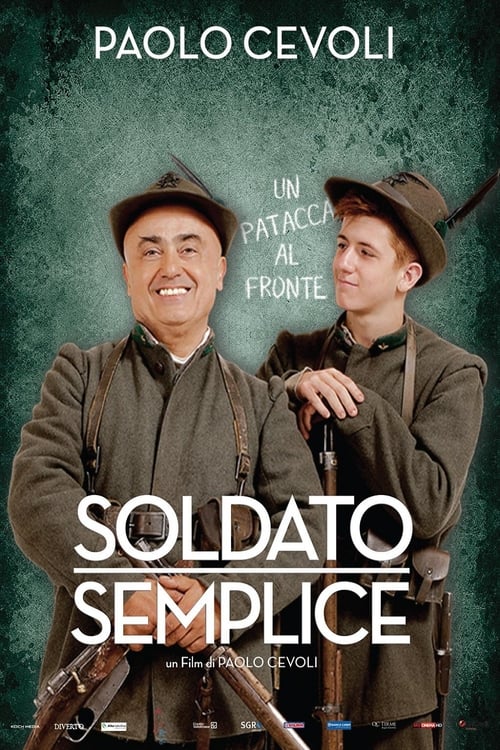
Soldato Semplice
Plot
In 1917, Gino Montanari, an elementary school teacher from Romagna, was forced by the principal of his school to volunteer for the First World War because of his libertine and anti-interventionist behavior. With the threat of being expelled from all schools if he refused, Gino was reluctantly sent to the front in a small outpost in Valtellina, where as a heliographer he had to transmit Morse signals with sunlight. His life would be profoundly changed by his encounter with a young illiterate man, with the enemy, and with a series of individuals from various parts of Italy.
Get the Weekly Woke Watchlist
New and trending movies scored for woke bias, preachy messaging, and forced political themes — before you waste your evening.
No spam. One useful email per week.
Overall Series Review
Categorical Breakdown
The narrative centers on the intersection of diverse Italian regional identities and dialects, framing these differences as a source of strength that ultimately forges friendship and national unity, not intersectional division. Character judgment is based on individual merit and moral fiber, exemplified by the positive portrayal of the illiterate young man and the villainy of the cruel sergeant. The film avoids race-swapping or the vilification of whiteness.
The film avoids civilizational self-hatred by presenting itself as an 'omaggio' to the ancestors and the sacrifices of the nation's grandfathers. While the plot critiques the specific tragedy and ineptitude of the military system through incompetent officers and the futility of the war, the narrative ultimately celebrates the 'beauties of the small Italy.' The film respects the core institutions of nation and family.
The protagonist, Gino Montanari, begins the film with an anti-natalist-adjacent stance, describing marriage as the 'tomb of love,' which reflects an individual anti-family viewpoint. However, the narrative arc is about his personal transformation away from this libertine philosophy. Female roles are minimal, primarily confined to secondary characters like the protagonist’s mother, preventing the use of 'Girl Boss' or 'Mary Sue' tropes. The focus is on traditional male-to-male friendship and paternal bonds.
The film is set in the authentic historical context of the Italian front in 1917 and centers on traditional male-female dynamics, contrasting the protagonist’s 'donnaiolo' nature with the supporting character's respect for traditional male-female pairing and family. There is no presence of alternative sexual ideologies, deconstruction of the nuclear family, or lecturing on gender theory.
The protagonist is introduced as an atheist and libertine, directly contrasting him with the simple, young soldier who holds strong moral principles of 'God, Fatherland, and Family.' This conflict is a central theme, and the protagonist's profound, positive change is implied to be due to his interaction with these traditional values. The final, overarching message of 'Sursum Corda' (Lift up your hearts) is spiritually transcendent, not anti-religious or anti-Christian.
Get the Weekly Woke Watchlist
New and trending movies scored for woke bias, preachy messaging, and forced political themes — before you waste your evening.
No spam. One useful email per week.