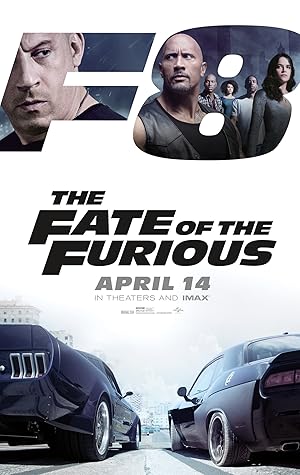
The Fate of the Furious
Plot
Now that Dominic Toretto (Vin Diesel) and Letty Ortiz (Michelle Rodriguez) are on their honeymoon, and Brian (Paul Walker) and Mia (Jordana Brewster) have retired from the game, and the rest of the crew has been exonerated, the globetrotting team has found a semblance of a normal life. But when a mysterious woman seduces Dom into the world of crime he can't seem to escape, and a betrayal of those closest to him, they will face trials that will test them as never before. From the shores of Cuba and the streets of New York City to the icy plains off the arctic Barents Sea, the elite force will crisscross the globe to stop an anarchist from unleashing chaos on the world's stage, and to bring home the man who made them a family.
Get the Weekly Woke Watchlist
New and trending movies scored for woke bias, preachy messaging, and forced political themes — before you waste your evening.
No spam. One useful email per week.
Overall Series Review
Categorical Breakdown
The main cast is remarkably diverse along racial and ethnic lines, which is a consistent feature of the franchise. However, characters are consistently judged and valued by their unique skills (driving, hacking, fighting) and their demonstrated loyalty to the 'family,' upholding a principle of meritocracy within the crew's operation. The plot does not use race to lecture on systemic oppression or vilify any group.
The central theme of the movie is the absolute importance of 'family' as an institution that provides stability and meaning, portraying it as a shield against chaos. The main antagonist is an anarchist aiming for global disorder. The narrative does not contain any hostility toward Western civilization, its heritage, or its institutions, but rather focuses on protecting a core societal structure (the family) on a global scale.
Female characters like the villain Cipher and team members Letty and Ramsey are shown to be highly competent, intelligent, and physically capable, fitting the 'Girl Boss' archetype through pure skill. However, the emotional core of the film is Dom's secret son, and the child's mother is killed to raise the stakes, a narrative move that subordinates the female role to the male hero's motivation. The plot strongly affirms fatherhood and the nuclear family.
The core conflict is built entirely around Dom's secret biological son and the protection of his heterosexual family unit, which is framed as the ultimate moral good. The movie operates entirely within a normative structure, and there is no inclusion, commentary, or explicit reference to alternative sexualities, gender identity, or the deconstruction of the nuclear family.
A transcendent, objective moral code of 'family' and loyalty drives every character's actions and is the undisputed source of the hero's strength and salvation. The narrative does not depict any hostility toward religion or faith, nor does it present a philosophy of moral relativism as a positive or central theme.
Get the Weekly Woke Watchlist
New and trending movies scored for woke bias, preachy messaging, and forced political themes — before you waste your evening.
No spam. One useful email per week.