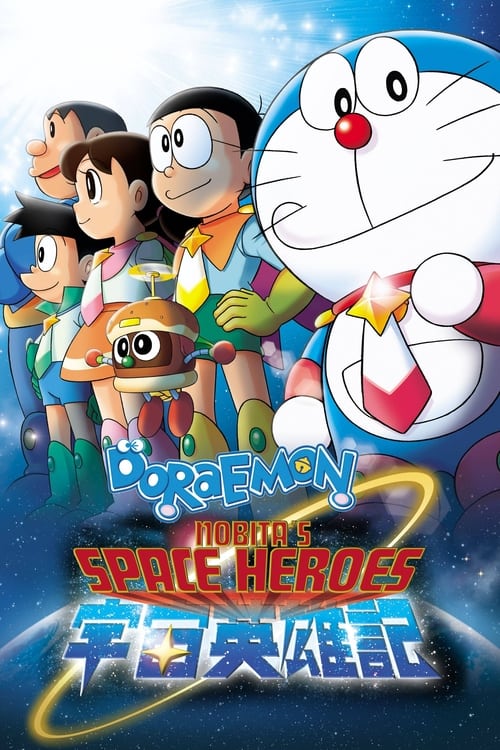
Doraemon: Nobita and the Space Heroes
Plot
One day Doraemon, Nobita, Shizuka, Gian and Suneo were shooting a film as space heroes. When they were shooting the film in the open lot a boy called Aron comes and alerts them of aliens attacking his planet. They agree to help him by turning into real superheroes, but it isn't as easy as it looks.
Get the Weekly Woke Watchlist
New and trending movies scored for woke bias, preachy messaging, and forced political themes — before you waste your evening.
No spam. One useful email per week.
Overall Series Review
Categorical Breakdown
The narrative does not rely on race or immutable characteristics. The main cast consists of Japanese children who are judged solely on their merit as heroes and friends. The villains are space pirates of various alien races, with the conflict being purely moral (good vs. evil) and economic (greed vs. protection) rather than based on any intersectional hierarchy. The focus is entirely on universal meritocracy and character development.
The film demonstrates no hostility toward the main characters’ home or culture. The Japanese children are the heroes who voluntarily leave Earth to help a distressed alien world, framing their institutions and values as a source of strength and altruism. The core conflict is a universal tale of protecting a smaller, innocent civilization from predatory corporate exploitation, with no demonization of the heroes' ancestors or heritage.
Shizuka, the female lead, is an integral and competent member of the team whose laser-beam superpower is frequently useful in fights, showing she is a strong contributor. Nobita, the male lead, is initially clumsy and has the 'most useless' power, which is a common character trope in the series, but ultimately he defeats the main villain alone, which affirms his masculinity and leadership. Men and women are complementary in their roles and abilities, and the narrative centers on universal heroism rather than gender lecture or female perfection.
The movie, as a 2015 children's science fiction film from a Japanese franchise, maintains a completely normative structure. It centers on the adventures and friendships of children. There is no presence of sexual identity as a key trait, no deconstruction of the nuclear family, and no lecturing on alternative sexualities or gender theory for children.
The conflict is purely secular and scientific, revolving around space travel, future gadgets, and corporate crime in space. Traditional religion is not featured in the plot. The moral law is transcendent—saving an innocent planet is objectively good, and destroying it for profit is objectively evil—but it is expressed through a humanistic and universal sense of right and wrong, not an anti-theistic or pro-Christian framework. The score is only slightly above 1 due to the absence of explicit spirituality, leaving a moral vacuum that is filled by secular humanism, which is a neutral stance.
Get the Weekly Woke Watchlist
New and trending movies scored for woke bias, preachy messaging, and forced political themes — before you waste your evening.
No spam. One useful email per week.