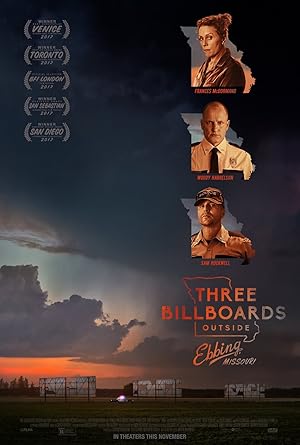
Three Billboards Outside Ebbing, Missouri
Plot
THREE BILLBOARDS OUTSIDE EBBING, MISSOURI is a darkly comic drama from Academy Award nominee Martin McDonagh (In Bruges). After months have passed without a culprit in her daughter's murder case, Mildred Hayes (Academy Award winner Frances McDormand) makes a bold move, painting three signs leading into her town with a controversial message directed at William Willoughby (Academy Award nominee Woody Harrelson), the town's revered chief of police. When his second-in-command Officer Dixon (Academy Award winner Sam Rockwell), an immature mother's boy with a penchant for violence, gets involved, the battle between Mildred and Ebbing's law enforcement is only exacerbated.
Get the Weekly Woke Watchlist
New and trending movies scored for woke bias, preachy messaging, and forced political themes — before you waste your evening.
No spam. One useful email per week.
Overall Series Review
Categorical Breakdown
The film directly introduces Officer Dixon as a 'virulent racist' with a history of brutalizing black prisoners, framing the white police force as a hub of systemic racism. A black character, Mildred's co-worker, is arrested by Dixon on petty charges as a form of retaliation. The narrative is heavily focused on the failure and vilification of white male authority and institutions.
The setting of a small, rural American town is depicted as a deeply corrupt and prejudiced society. The primary Western civic institution, the police, is shown to be largely inept and violent. This framing presents the core 'home culture' and its systems as fundamentally toxic and failed.
The protagonist, Mildred Hayes, is a highly aggressive and individualistic female lead taking on a 'patriarchal' institution. The male figures are either the 'toxic' ex-husband, the bumbling/racist Officer Dixon, or the dying Chief Willoughby, all of whom are flawed or overcome by the protagonist's force. The pursuit of career/vengeance is centered, and Mildred is an explicitly abusive mother, undermining any traditional celebration of motherhood.
Alternative sexualities and gender ideology are not central to the plot. The film makes only brief, comedic references to various marginalized groups, which prevents a perfect low score but keeps the focus on the main conflict and does not attempt to normalize a new sexual ideology.
The film features a direct, explicit confrontation where the protagonist dismisses a Catholic priest by comparing the Church's historic complicity in sexual abuse to a violent street 'gang.' This sequence demonstrates a clear hostility toward traditional religion and its institutional role in the community, framing it as another failed, hypocritical authority.
Get the Weekly Woke Watchlist
New and trending movies scored for woke bias, preachy messaging, and forced political themes — before you waste your evening.
No spam. One useful email per week.