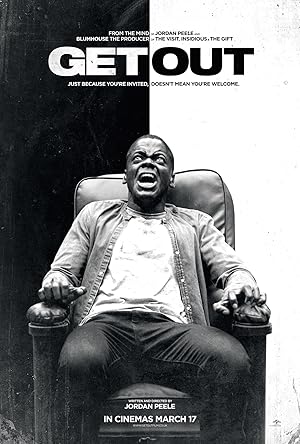
Get Out
Plot
Chris and his girlfriend Rose go upstate to visit her parents for the weekend. At first, Chris reads the family's overly accommodating behavior as nervous attempts to deal with their daughter's interracial relationship, but as the weekend progresses, a series of increasingly disturbing discoveries lead him to a truth that he never could have imagined.
Get the Weekly Woke Watchlist
New and trending movies scored for woke bias, preachy messaging, and forced political themes — before you waste your evening.
No spam. One useful email per week.
Overall Series Review
Categorical Breakdown
The entire story centers on the protagonist's race as the sole reason for his persecution and the villains' desire. The Armitage family and their guests, representing the affluent white liberal class, are collectively depicted as being complicit in a horrific, multi-generational system of systemic oppression and body theft. The plot's main reveal is that the antagonists fetishize and exploit the protagonist's immutable characteristics, not his character or merit. The antagonist explicitly rejects the trope of the 'last good white person,' confirming a narrative structure that vilifies the white cohort in the story.
The traditional, beautiful country home of the affluent Armitage family is established as the central location for a deeply evil, dehumanizing operation. The narrative frames this symbol of comfortable, liberal, upper-class American life as inherently corrupt and built upon the theft and objectification of other people. The ancestors of the Armitage family are directly tied into this multi-generational, criminal scheme, demonstrating that the family's heritage is founded on malevolence.
The main antagonist is a young woman who actively participates in the evil scheme, acting as the competent, calculating recruiter and betrayer who lures the male victims to the family's estate. Her mother uses her professional skills to hypnotize the victims and prepare them for their fate. While women are highly effective within the antagonist group, the male protagonist is shown to be capable, resourceful, and ultimately the victor of the conflict.
The film's narrative conflict focuses entirely on race and does not include any subplots or thematic exploration related to non-normative sexuality or gender ideology. The central relationship is heterosexual, and the nuclear family is merely a cover for a bizarre, criminal operation, not a subject for ideological deconstruction.
The villains are presented as a collective of wealthy, secular elite who believe they can achieve a form of twisted immortality and physical superiority by literally commodifying other human beings. The entire premise is built on a moral vacuum where subjective, materialistic desire (for physical health and prolonged life) justifies the objectification, slavery, and murder of others. There are no religious characters in the film.
Get the Weekly Woke Watchlist
New and trending movies scored for woke bias, preachy messaging, and forced political themes — before you waste your evening.
No spam. One useful email per week.