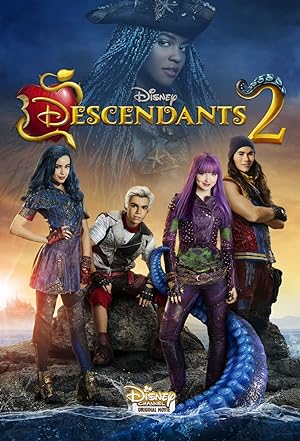
Descendants 2
Plot
When the pressure to be royally perfect becomes too much for Mal, she returns to her rotten roots on the Isle of the Lost where her archenemy Uma, the daughter of Ursula from The Little Mermaid, has taken her spot as self-proclaimed queen of the run-down town. Uma, still resentful over not being selected by Ben to go to Auradon Prep with the other Villain Kids, stirs her pirate gang including Captain Hook's son Harry and Gaston's son Gil, to break the barrier between the Isle of the Lost and Auradon, and unleash all the villains imprisoned on the Isle once and for all.
Get the Weekly Woke Watchlist
New and trending movies scored for woke bias, preachy messaging, and forced political themes — before you waste your evening.
No spam. One useful email per week.
Overall Series Review
Categorical Breakdown
The narrative directly sets up a conflict between the privileged hero-descendants in the wealthy, gleaming kingdom of Auradon and the oppressed villain-descendants trapped in the impoverished, ghetto-like Isle of the Lost. The film focuses on the systemic inequality that prevents the Isle's children from having the same opportunities as the Auradon elite, making it an on-point parable for class discrimination. Uma, a powerful female antagonist, is specifically framed by some analysis as a villainous portrayal of a working-class woman of color, a choice that reinforces negative cultural narratives. Characters are judged heavily by their birthplace and parentage, and the plot exists to force the 'good' kingdom to address its systemic failures and expand diversity to more of the villain population.
The film’s central drama is a critique of the Western-style, traditional monarchy of Auradon. Protagonist Mal rejects the institution's pressure for 'royal perfection,' framing the hero's society as stifling and forcing her to 'closet' her true self. The plot directly chastises the ancestors of Auradon for instituting the barrier, which is labeled an institutional 'wrong' and a failure of the 'good' kingdom to practice what it preaches. However, the solution is not the destruction of Auradon, but its reform through King Ben’s pursuit of inclusion and acceptance, pulling the score back from a complete civilizational self-hatred rating.
Female characters are the undisputed central figures and leaders of the plot. Mal and Uma are the primary drivers of the conflict and resolution, defining the action in a high-intensity 'Girl Boss' rivalry. Mal is an empowered female protagonist poised to be queen, and Uma is the self-proclaimed pirate captain and queen of the Isle. Lonnie, the daughter of Mulan, successfully pushes for gender equality by joining the male-dominated fencing team. The main male characters, particularly King Ben, have their primary function revolve around their relationships with the powerful female leads, being easily enchanted by and constantly pursuing the female antagonists, which positions him as a less capable leader than his female counterpart.
The core of the movie's central relationship is unequivocally heterosexual, featuring the continued romance between Mal and King Ben. However, the film contains strong undertones of queer coding. The primary emotional core is the duet and bond between Mal and her female best friend Evie, which has been read by fans as a romantic relationship. Furthermore, the conflict is framed as Mal’s struggle to resist conforming to societal expectations and embrace her 'true self,' which is explicitly interpreted by the actress as a queerly-coded narrative. A moment between male characters Harry and Gil, which was perceived as a same-sex kiss, was left out of the final film and was said to be an unscripted moment, indicating the presence of the themes in production but their removal before broadcast.
The narrative's moral framework centers on choice and acceptance—the children can choose to be 'good' regardless of their 'evil' ancestry. This promotes a moral subjectivity where what is 'good' or 'evil' is less about transcendent moral law and more about personal sincerity and social context (Mal and Uma's 'evil' actions are often for understandable reasons, like survival or fighting for social justice). The conflict is not presented in explicitly religious terms. While there is no direct hostility toward traditional religion, the morality presented is entirely secular, resting on the subjective choice of the individual and the social contract of the kingdom, which substitutes Objective Truth for emotional fulfillment and acceptance.
Get the Weekly Woke Watchlist
New and trending movies scored for woke bias, preachy messaging, and forced political themes — before you waste your evening.
No spam. One useful email per week.