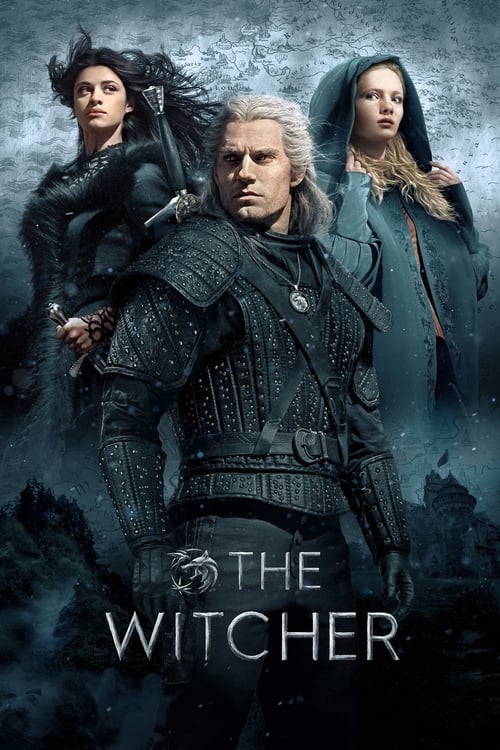
The Witcher
Season 1 Analysis
Season Overview
The witcher Geralt, a mutated monster hunter, struggles to find his place in a world in which people often prove more wicked than beasts.
Season Review
Categorical Breakdown
The production includes extensive 'race-swapping' of established characters like Fringilla and Triss, placing actors of color in roles canonically described as White in a world inspired by Polish culture. This decision demonstrates a clear prioritization of forced diversity. The narrative heavily relies on the theme of systemic oppression, depicting human society as universally bigoted against non-humans, though this theme originates in the source material.
The series portrays the Northern Kingdoms, the dominant human culture analogous to a medieval European setting, as overwhelmingly corrupt, tyrannical, and consumed by vice. Kings are shown as incestuous or cruel, and knights are violent oppressors. The invading Nilfgaardian Empire is framed in contrast, sometimes presented as more progressive in its treatment of non-humans, depicting the 'home' human culture as fundamentally evil.
Female characters like Yennefer, Tissaia, and Queen Calanthe hold nearly all institutional power in the magical and political spheres. Yennefer's extensive backstory focuses on her choice to trade her potential for motherhood—her uterus—for her full magical power and beauty, centering on an anti-natal message that elevates career and personal power over a traditional family role. The male lead, Geralt, is an emotionally closed-off archetype who operates on the margins, reacting to the female-driven power structures.
The score is low because there are no major explicit LGBTQ+ characters in Season 1. The representation is limited to subtext through the male character Jaskier, whose devoted following of Geralt and romantic-style jealousy over Yennefer is widely interpreted as 'queer-coding.' There is no central plot on sexual identity or lecturing on gender ideology.
Organized religion, particularly the most prevalent human faiths, is systematically depicted as a malevolent force. The clergy are shown as fanatics or power-hungry hypocrites who instigate witch hunts and mob violence against perceived outsiders and mages. The show emphasizes Geralt’s personal, nihilistic morality of choosing the 'lesser evil,' which functions as a form of moral relativism superseding objective or transcendent moral law.