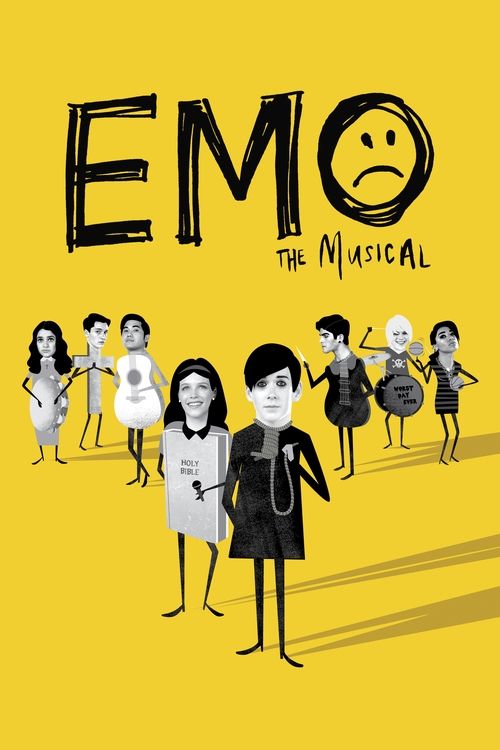
Emo: The Musical
Plot
Ethan, a sullen high-school student whose life is defined by what he hates, finds love with a blindly optimistic Christian girl Trinity, much to the annoyance of his angst-filled band mates and her evangelistic brethren.
Get the Weekly Woke Watchlist
New and trending movies scored for woke bias, preachy messaging, and forced political themes — before you waste your evening.
No spam. One useful email per week.
Overall Series Review
Categorical Breakdown
The narrative's central conflict is between subcultures (Emos and Christians), not primarily on race or immutable characteristics. Characters are judged by the content of their chosen subcultural identity (angst vs. faith). The film does employ exaggerated stereotypes for a diverse cast, including one instance of a racial stereotype for a minor character, but the overarching theme is a critique of clique-based, performative identity rather than systemic oppression.
The film’s setting is a standard high school environment in Australia. The critique is aimed narrowly at school administration and the commercialization of mental health (the school is funded by a pharmaceutical company), which is an institutional critique. There is no hostility toward Western civilization, home culture, or ancestors.
The core plot focuses on a traditional male-female romantic pairing between Ethan and Trinity. The female characters are not depicted as 'Mary Sues' or 'Girl Bosses' in the anti-male sense. Trinity is a devout Christian love interest, while the emo girlfriend, Roz, is possessive and aggressive. The score reflects Roz’s negative, emasculating role as a restrictive girlfriend, but there is no anti-natalism or broader anti-family messaging.
The film includes jokes about Christian prejudice against gay people. Supporting characters are explicitly gay-coded or have humor derived from their denial of their sexuality. A secondary, extremely emo character is noted for a homosexual act, framed to exaggerate his 'emo' status. This centering of alternative sexualities and the use of the 'hating the gays' stereotype for the Christian clique warrants a high score, even though the central romance is heterosexual.
The Christian characters are depicted as stereotypical, 'blindly optimistic,' 'naïve,' 'annoyingly insistent,' and living in a 'restrictive world of dogma and denial,' often failing to practice what they preach. Both the emo 'nihilism' and Christian 'dogma' are equally parodied as silly, performative teenage cliques, placing the film's moral framework within a subjective, relativistic worldview. The humor directly targets the performative nature and hypocrisy of organized faith, achieving the 10/10 descriptor of traditional religion being framed as a root of evil/bigotry within the high school ecosystem.
Get the Weekly Woke Watchlist
New and trending movies scored for woke bias, preachy messaging, and forced political themes — before you waste your evening.
No spam. One useful email per week.