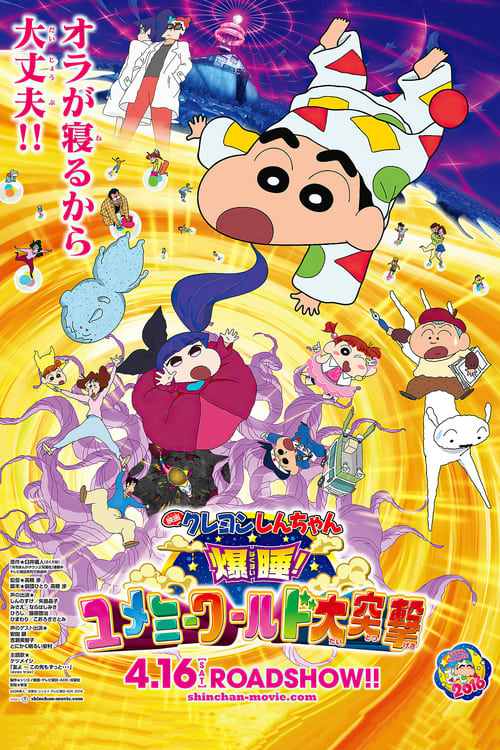
Crayon Shin-chan: Fast Asleep! Dreaming World Big Assault!
Plot
One night, the Nohara family were enjoying a pleasant dream, when suddenly a big fish appeared in their dreams and ate them. The next morning, Hiroshi read in the newspaper that everybody in another town had the same nightmare as him, but it seemed to have ended. But Hiroshi also heard the same dream from Misae, Shinnosuke, Himawari and even Shiro. They were surprised and thought if the same thing is happening in Kasukabe too. In kindergarten, on telling others about his nightmare, Shinnosuke was surprised to know that everybody too had the same dream. Then a mysterious girl named Saki was transferred to Futaba Kindergarten and joined Shinnosuke's class. Everyone in the class, including the rather inactive Bo-chan, were all excited and happy on seeing her. But Saki had a cold attitude and didn't get along well.
Get the Weekly Woke Watchlist
New and trending movies scored for woke bias, preachy messaging, and forced political themes — before you waste your evening.
No spam. One useful email per week.
Overall Series Review
Categorical Breakdown
The narrative centers on trauma, friendship, and family, which are universal human themes. Character motivations are based on deep emotional connections and personal history, not on race or immutable characteristics. There is no focus on privilege, oppression, or forced diversity.
The movie treats the central institutions—the Nohara family and the community of Kasukabe—as the bedrock of stability. The home and family unit are framed as protective shields against the existential chaos of the nightmare world. No aspect of Japanese or Western civilization is maligned or deconstructed.
Misae, the mother, takes the role of the final hero, defeating the main antagonist and providing the key emotional resolution, demonstrating a protective and vital form of female power. The narrative strongly celebrates motherhood and the nuclear family, emphasizing the mother's unconditional love and sacrifice as the highest virtue. This aligns with Complementarianism rather than a 'Girl Boss' or Anti-Natalist message.
The story adheres to a normative structure, centering on the traditional male-female Nohara pairing and the nuclear family unit. Sexual identity and gender ideology are entirely absent from the plot, which focuses on childhood trauma and parental devotion.
The conflict incorporates a mythological element—the Baku, a dream-eating spirit from Japanese folklore—which is a cultural and spiritual reference point. The moral framework is objective, advocating for the acceptance of objective truth (i.e., loss and grief) as the path to peace. There is no critique or vilification of traditional religion.
Get the Weekly Woke Watchlist
New and trending movies scored for woke bias, preachy messaging, and forced political themes — before you waste your evening.
No spam. One useful email per week.