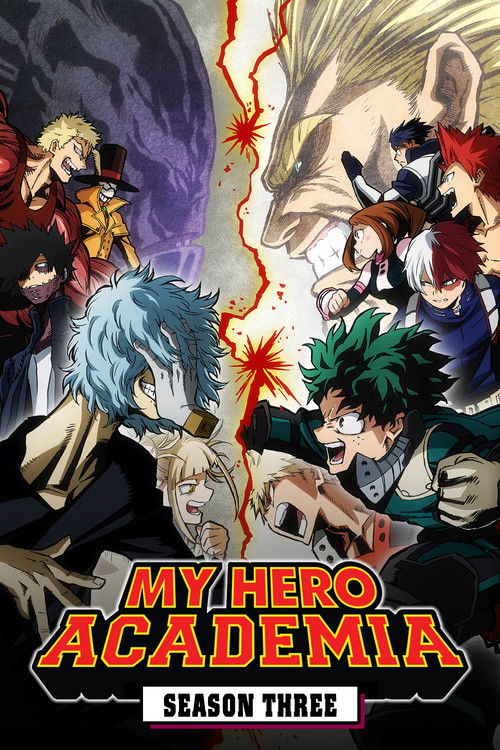
My Hero Academia
Season 3 Analysis
Season Overview
Summer is here and the heroes of Rooms A and B are in for the toughest training camp of their lives! A group of seasoned professionals will push the students individualities to the next level with one new challenge after another. Braving the elements of this secret location will be the least of their worries as routine training turns into a grueling fight for survival.
Season Review
Categorical Breakdown
Characters are judged primarily by their Quirk's power and their willingness to commit to hero ethics, establishing a foundation of meritocracy. However, the narrative introduces a critique of the 'Hero society' being 'superficial' and discriminatory against individuals with 'scary' or 'mutant-type' appearances, using this as a driver for some villains. This allegory for systemic oppression based on immutable characteristics elevates the score, as it mirrors an intersectional lens, even though the protagonist's journey focuses on merit and overcoming personal weakness.
The season contains a strong element of civilizational critique where the existing 'Hero society' is exposed as flawed and reliant on a single pillar (All Might). The media and public lose faith, questioning the competence and motives of the heroes and the training institutions. This hostility toward the 'home' system raises the score. However, the protagonists' actions—particularly All Might's ultimate sacrifice and the pro-heroes' organized counter-attack—are framed as an effort to defend and restore the integrity of the institutions, not to destroy them, which prevents a higher score.
Female characters like Yaoyorozu, Uraraka, and Tsu are competent and integral to key plot points, particularly the Provisional Hero License Exam, but are not portrayed as instantly perfect 'Mary Sues.' Their professional goals are often tied to supporting their families or using their skills to protect others, not solely anti-natalist career fulfillment. Male characters like Midoriya, All Might, and Bakugo are the main drivers of the plot and exhibit strength and sacrifice, avoiding emasculation tropes. The gender dynamics are generally complementary and merit-based.
The plot focuses entirely on hero training, villain attacks, and the moral battle between All Might and All For One. Sexual orientation or gender identity is not a topic of discussion or a defining characteristic for any major character. The narrative adheres to a normative structure without introducing or lecturing on queer theory or deconstructing the nuclear family unit, which is briefly touched upon as a positive ideal through the backstory of All Might's mentor.
The core theme is a spiritual battle between the 'Symbol of Peace'—a figure of self-sacrificing objective good—and the nihilism of All For One, who embodies subjective power dynamics. The narrative champions courage, justice, and the selfless act of a hero as a higher moral law that transcends self-interest. There is no hostility toward traditional religion, and the moral framework is clearly objective, not relativistic.