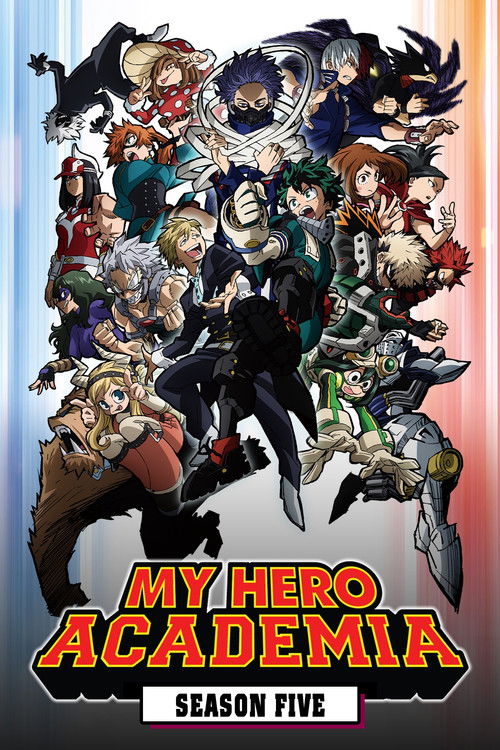
My Hero Academia
Season 5 Analysis
Season Overview
Deku's next challenge, in order to become the "best hero," is a rivalry with Class 1-B, who also intend to prove that they are true heroes, with all their pride on the line! The students' morale is boosted by a direct confrontation that hasn't occurred since the sports festival. Meanwhile, a new "something" is about to awaken within Deku.
Season Review
Categorical Breakdown
The core plot of the season's second half focuses on the villains, whose origins are explicitly rooted in a 'Quirk Society' that practices systemic discrimination and prejudice against those with marginalized characteristics (mutant Quirks and 'scary' abilities). The villain characters are framed as victims of a system that judges based on immutable, inborn traits rather than individual merit, which is a direct allegorical parallel to intersectional identity politics. The hero side, however, operates on a universal meritocracy of effort and ethical heroism.
The narrative criticizes the fictional 'Hero Society' and its regulating institutions for being corrupt, superficial, and failing the people they vow to save. This is an internal criticism of a specific, fictional Japanese system. It is not a demonization of Japan's history, ancestors, or Western civilization. The heroes themselves operate from a position of gratitude and respect for the institution's founding principles, seeking reform over destruction.
The main focus of the season's significant arcs is on the development and rivalry of the male leads: Deku, Bakugo, and Todoroki, and the male villain Shigaraki. Female characters remain largely competent support figures. There are no 'Mary Sue' or 'Girl Boss' characters whose perfection instantly resolves conflict. Male characters are celebrated for their power and sacrifice. The show adheres to traditional shonen genre dynamics with a prominent focus on male development and minimal anti-natalist or emasculating messaging.
The season features minor or supporting characters who are established as part of the LGBTQ+ community, which is simply a characteristic of the world's population. This representation exists, but the plot itself does not center on sexual identity, deconstruct the nuclear family, or include any lecturing on gender theory. The focus remains on heroism and power development.
The series is entirely secular and establishes a foundational system of objective moral law where heroism is good and villainy is evil. The heroes pursue the Transcendent Morality of saving others at great personal sacrifice. There is no religious commentary, no vilification of traditional religion, and no promotion of moral subjectivity outside of the villains' own self-justifying ideologies.