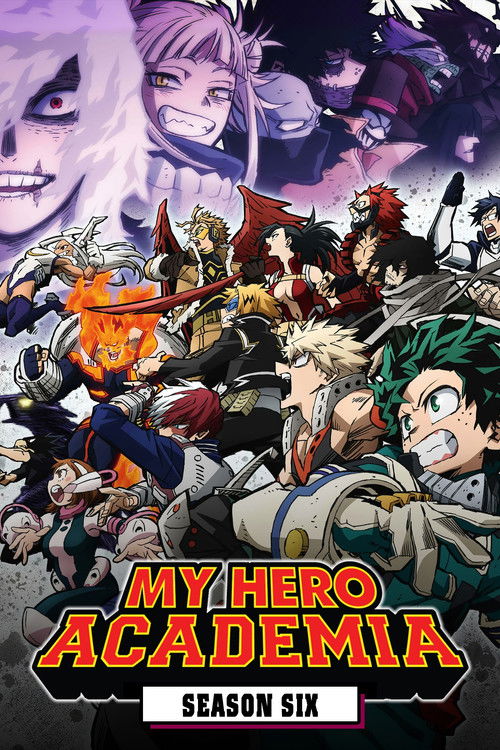
My Hero Academia
Season 6 Analysis
Season Overview
Along with Bakugo and Todoroki, Deku interned at the office of the No. 1 Hero, Endeavor. Working hard in an environment rich in lessons, he improved as a hero and used Black Whip, a new Quirk that was hidden within One For All.
Season Review
Categorical Breakdown
The narrative features a clear storyline where a large group of people (Heteromorphs) are persecuted solely because of their physical 'Quirk' appearance, framing this 'immutable characteristic' as the basis for a 'systemic oppression' in the Hero Society. Historical massacres and lynchings are referenced as the foundation for this societal division, leading to a segment of this marginalized group joining the villains.
The central dramatic payoff of the season is the total collapse of the Hero Society as an institution, with the public's trust being 'shattered.' The system's 'failures and limitations' are exposed, framing the nation's core governing structure as fundamentally corrupt and based on a lie. This harsh critique of the civilization's main institution aligns with a deep hostility toward the established home culture.
Female Pro Heroes like Mirko receive prominent action roles and are shown as highly competent leaders who 'drive the narrative forward' in the climactic battles. However, the ultimate fate of the world rests on the primary male protagonists and antagonists. The core emotional and plot-driving arcs remain centered on the relationships and struggles of men, with no prominent 'emasculation of males' or 'anti-natal' messaging present.
The series includes canonically queer characters, specifically a transgender hero and a bisexual villain, who appear in this season's narrative. However, the season does not dedicate any central plotline to 'deconstructing the nuclear family,' lecture on 'gender theory,' or center the story around alternative sexualities. The presence is low and secondary to the main conflict.
The main ideological conflict is between the villain All For One/Shigaraki's nihilistic philosophy that ‘morality is subjective power dynamics’ and the hero Deku’s unwavering commitment to 'saving others' through self-sacrifice. While the villain embodies the 10/10 view of moral relativism, the entire story works to validate the hero's 'Transcendent Morality' as the objective and correct ideal, pulling the final score down toward the lower end.