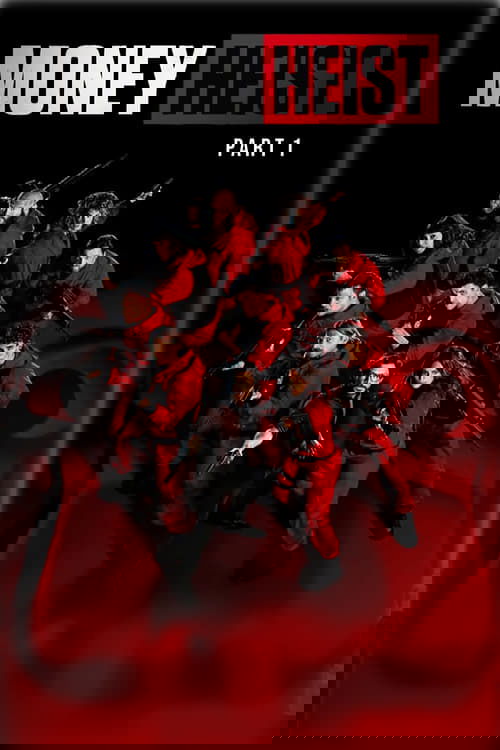
Money Heist
Season 1 Analysis
Season Overview
Under the guidance of The Professor, a group of eight very peculiar robbers have attacked the National Coinage and Stamp Factory of Spain and took hostages to carry out the most perfect robbery in the history, aiming to take home 2.4 billion Euros in cash.
Season Review
Categorical Breakdown
The narrative focuses on social and economic inequality, framing the Spanish financial and political system as the antagonist. The diverse cast of criminals is selected entirely based on their specialized skills and their backstory of hardship. The central conflict is fundamentally a class-based or anti-systemic one, not a lecture on intersectional hierarchy or racial privilege.
The entire premise is a hostile critique and direct physical attack on a central institution of the Spanish state, the Royal Mint. The robbers are consistently portrayed as heroic 'resistance fighters' or 'Robin Hood' figures, with their actions justified because the government and system are the 'true thieves.' The frequent use of the anti-fascist anthem 'Bella Ciao' reinforces a political message that demonizes the current national establishment.
The story consciously centers powerful female characters in leadership on both the robbery side and the police negotiation side. The creator explicitly aimed for a female perspective, exemplified by Tokyo's role as the narrator. One of the main internal antagonists, Berlin, is characterized as a misogynistic man and a sexual predator, which positions the female characters' struggles as a clear counter-narrative against male toxicity. The declaration 'Now the Matriarchy begins' is used during a moment of internal power struggle.
The character Helsinki is established as an openly gay member of the crew. His sexuality is an intrinsic trait of the character but remains mostly a background detail to his function in the heist and his personal attachments. His identity is not centered as the most important element of the plot, nor is there any overt political messaging related to sexual ideology.
The series completely substitutes a traditional moral framework with a purely secular, political, and relativistic one. The moral vacuum is filled by the doctrine that the state is corrupt, and therefore the criminals' actions are ethically justifiable, even heroic. Morality is treated as entirely subjective, based only on power dynamics and the audience's perception of who is the lesser of two evils.