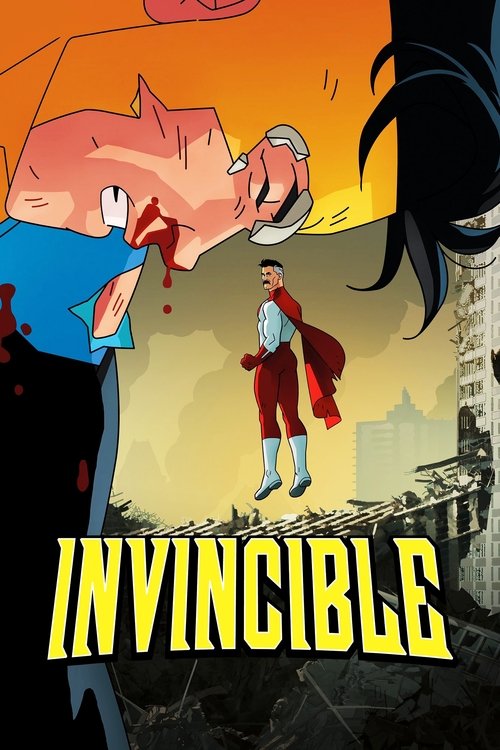
Invincible
Season 1 Analysis
Season Overview
Nolan Grayson (Omni-Man) is unquestionably the strongest being on our planet; he is also our most spirited protector, having saved the planet from untold calamity. His son Mark, wants nothing more than to follow in his footsteps. But there's something sinister afoot and Omni-man may not be what he appears. Which may prove even too much for the Guardians of the Globe.
Season Review
Categorical Breakdown
The adaptation features significant race-swapping, changing Mark Grayson's mother, Debbie, and Mark himself to be half-Asian, and changing his first major love interest, Amber Bennett, from a white character to a black character. The series creator publicly justified this change as a necessity to correct the lack of diversity in the original comic created by 'dumb white guys.' Amber’s dialogue includes a direct mention of her taking 'social justice classes' at the university. Omni-Man, the most powerful white-presenting male in the universe, is the ultimate villain, depicted as a fascist colonizer with a supremacist ideology, which critics interpret as a critique of 'privilege' and 'white male power.'
The main villain, Omni-Man, dedicates a significant portion of the final episode to lecturing his half-human son, Mark, on the utter meaninglessness and fragility of human life and culture, which he views as 'primitive' and beneath his own 'superior' Viltrumite civilization. The villain's entire agenda is rooted in a conquest-based, self-aggrandizing contempt for Earth, which perfectly aligns with the vilification of 'one's own home.' Mark's moral arc is framed by his rejection of this alien contempt and his fierce, self-sacrificial defense of Earth and humanity, which acts as the narrative's moral counterpoint.
Female characters are given increased agency, with Mark's mother, Debbie, being a prominent example. She develops a strong, independent investigator's arc in response to her husband's deception, going beyond her role in the source material to become the family's emotional and moral core. Atom Eve is developed as a competent hero with a personal motivation independent of the male protagonist. The central male villain, Omni-Man, embodies a 'toxic' hyper-masculine, patriarchal, and anti-natalist philosophy, stating he could 'always start again, make another kid,' an outlook the narrative presents as unambiguously evil. The show strongly elevates an empathetic, nurturing form of masculinity (Mark) over the toxic patriarch.
The main protagonist's best friend, William Clockwell, is introduced as openly gay from the first episode, a change from the comic where his coming-out was a lengthy, slow-burn plot point. This character is immediately accepted by Mark and his peers, normalizing the presence of a non-heterosexual character without any societal conflict. The character is portrayed with flamboyance and immediately expresses attraction to Mark’s father. This immediate insertion of the alternative sexuality, removing the coming-out struggle entirely, moves the narrative away from the 'Normative Structure' and towards centering alternative identities.
The main philosophical conflict is between the inherent value of human life (championed by Mark) and the ultimate meaninglessness of human life in the face of deep time and superior power (championed by Omni-Man). The antagonist is a nihilist who promotes a 'might makes right' moral relativism. The narrative's moral compass is firmly aligned with the protagonist, who fights for an objective value of human life. While traditional religion is largely absent, the story affirms the existence of a higher moral law by framing its rejection as genocidal evil.