Invincible
Season 3 Analysis
Season Overview
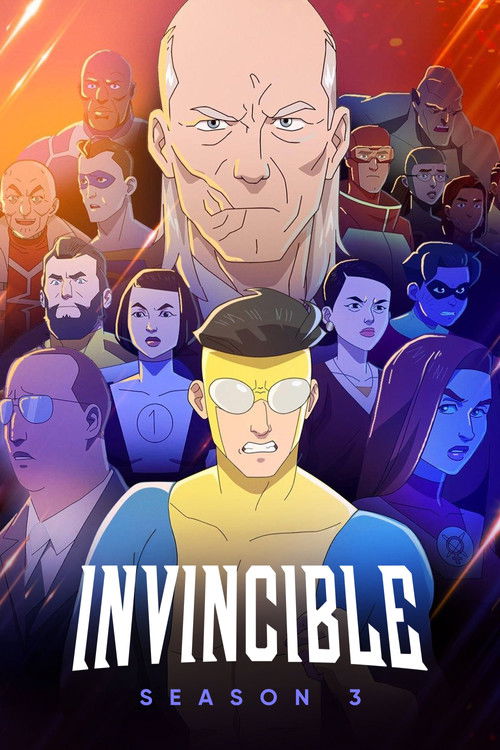
Everything changes as Mark is forced to face his past and his future, while discovering how much further he'll need to go to protect the people he loves.
Season Review
Categorical Breakdown
The series' structural elements, such as the comic-to-show race-swapping of Amber and the diverse casting in major roles, demonstrate a commitment to forced insertion of diversity. A prominent subplot reframes two villains' return to crime as being driven by socio-economic factors and homelessness, suggesting a systemic critique rather than focusing on individual moral failure. The central narrative, however, remains focused on Mark's struggle against an imperialistic, non-Earth race, which is not an indictment of 'whiteness.'
The central conflict is the defense of Earth and its people from the Viltrumite Empire, which is portrayed as an alien, eugenicist, and totalitarian society. Mark's fight is one to protect his home, his family, and humanity from this external threat. This primary theme counters a narrative of civilizational self-hatred. A minor plot point that critiques Earth's socio-economic institutions for failing its people keeps the score from the lowest possible rating.
Female characters like Atom Eve are powerful, competent superheroes, but the show takes time to show their personal challenges, trauma, and complex relationships. Mark's mother, Debbie Grayson, is a non-powered character whose arc centers on her resilience and dedication to reconstituting her family (Mark and Oliver), which celebrates the protective, maternal role. The narrative does not depict males as bumbling or motherhood as a prison, maintaining a balance.
Mark's best friend, William, remains an openly gay character, a change from the source material that removes a traditional character arc for the sake of immediate representation. The season introduces a pair of minor super-villains who are an explicitly featured gay couple struggling with poverty and a social commentary plot. Alternative sexualities are present and visible, but they do not deconstruct the main narrative's focus on the heterosexual relationship between Mark and Atom Eve.
The core dramatic tension of the season is an explicit, intense exploration of moral relativism versus Mark's black-and-white moral idealism. The plot is driven by the dilemma that Mark may have to embrace a subjective, utilitarian morality—killing the unredeemable for the 'greater good'—to save the world. The central question the season asks is whether being 'the good guy' is compatible with survival, which directly promotes the concept that morality is subjective.