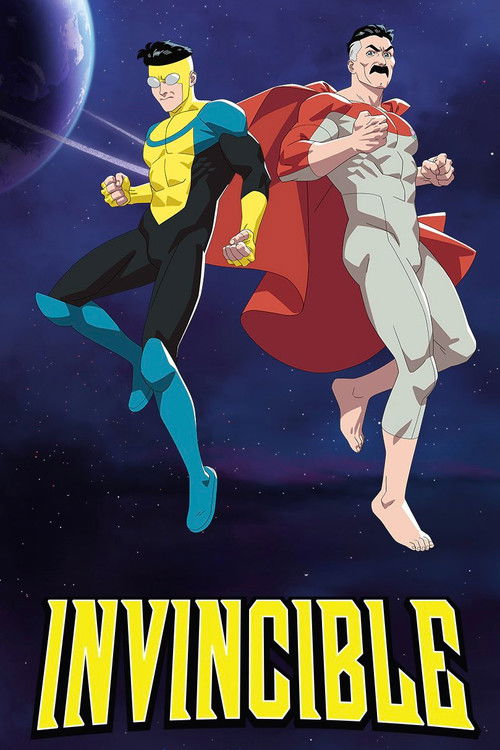
Invincible
Season 4 Analysis
Season Overview
While the world recovers from catastrophe, a changed Mark fights to protect his home and the people he loves, setting him on a collision course with a threat that could alter the fate of humanity forever.
Season Review
Categorical Breakdown
The central protagonist, Mark Grayson, and his mother, Debbie, are a key instance of 'race-swapping' to a half-Asian identity, which the creator explicitly justified as a correction for the 'lack of diversity' in the original material. Mark's primary love interest, Amber, is also race-swapped to Black. The main conflict of Season 4, the Viltrumite War, pits an intersectionally diverse alliance (The Coalition) against a powerful, genetically pure alien colonizing force (Viltrumites), framing the war as a battle against eugenics and systemic intergalactic oppression, a direct narrative application of the 'intersectional lens.'
The 'Western civilization' equivalent, represented by the white-coded Omni-Man, was introduced as a charismatic colonizer whose betrayal was an act of civilizational destruction. The organization tasked with protecting Earth, led by the white male Cecil Stedman, is consistently portrayed as morally compromised and overly pragmatic, relying on morally gray science and surveillance to protect the planet. While the goal of the Viltrumite War is to protect Earth (gratitude), the leadership structures responsible for that defense remain deeply suspect and untrustworthy, creating a perpetual cynicism toward established home institutions.
Atom Eve's character is elevated to a flawless moral authority and a 'Girl Boss' archetype with virtually limitless power, who received a dedicated special to re-establish her foundational heroism, which aligns with the 'Mary Sue' trope. Debbie Grayson is defined by her journey away from a traditional role as a wife/mother to a patriarchal super-being, finding self-worth and independence only after his betrayal. Season 4 is expected to feature Atom Eve dealing with changing powers and Mark/Eve relationship issues. If her comic-arc pregnancy is included, the narrative surrounding the 'anti-natalism' theme will depend on whether motherhood is shown to impede her destiny as a hero.
The show incorporates representation by changing a minor male comic character to be homosexual in the show, establishing a non-normative structure in the secondary cast. However, the core relationship of the main storyline remains a male-female pairing. The high-action focus of the Viltrumite War arc leaves little narrative space for centering sexual identity or extensive 'gender theory' lecturing, keeping the score moderate rather than extreme.
The narrative avoids focusing on traditional Earth-based religion (specifically Christianity) entirely, neither explicitly demonizing it nor embracing it as a source of strength. The primary villains are motivated by alien racial ideology and conquest, not a religious faith. The moral grayness and difficult choices faced by the heroes and Cecil are matters of philosophical and political utilitarianism, which constitutes a 'Spiritual Vacuum' rather than direct 'Anti-Theism.'