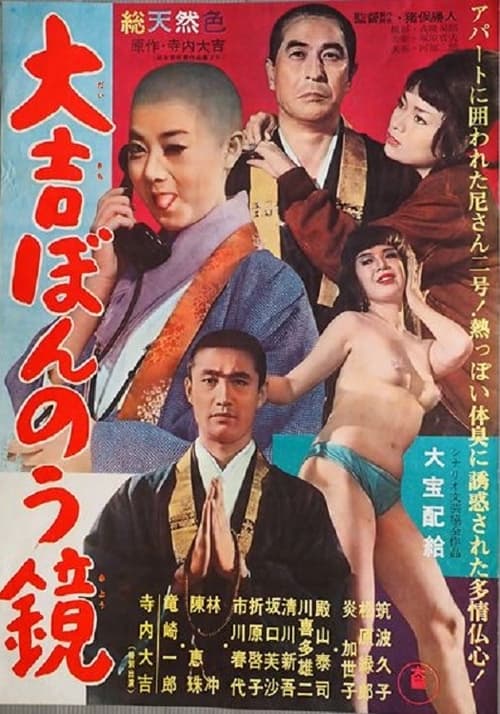
大吉ぼんのう鏡
Plot
Get the Weekly Woke Watchlist
New and trending movies scored for woke bias, preachy messaging, and forced political themes — before you waste your evening.
No spam. One useful email per week.
Overall Series Review
Categorical Breakdown
The narrative focuses on the internal and external moral conflict of a man—a revered priest—who succumbs to corruption and worldly desire. Character is judged entirely by his actions and spiritual integrity; the casting is homogeneous and unrelated to race, forced diversity, or modern intersectional hierarchy.
The story exposes the corruption and hypocrisy of a respected figure within a Japanese institution (the Buddhist priesthood) but does not condemn the nation, culture, or ancestors entirely. The critique targets human failing and violation of the standard, not the fundamental corruption of the home culture itself.
The central drama is a moral and political struggle involving a male priest and his pursuit of power. The narrative does not contain 'Girl Boss' tropes, the emasculation of males, or anti-natal messaging.
The narrative focuses entirely on the spiritual and political corruption of a Buddhist priest. Sexual identity, gender theory, or the centering of alternative sexualities is absent from the core plot.
The movie is a moral critique of a priest who violates his sacred vows for worldly gain, directly engaging with spiritual concepts like 'Bonno' (worldly desires) and Buddhist precepts as an objective moral law. The narrative judges the failure of the individual, not the religion itself, which retains its moral standard.
Get the Weekly Woke Watchlist
New and trending movies scored for woke bias, preachy messaging, and forced political themes — before you waste your evening.
No spam. One useful email per week.