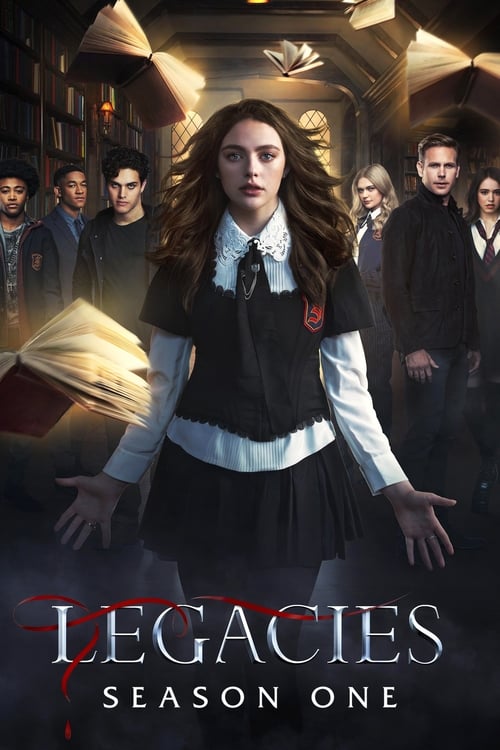
Legacies
Season 1 Analysis
Season Overview
Continuing the tradition of The Vampire Diaries and The Originals, the story of the next generation of supernatural beings at the Salvatore Boarding School for the Young & Gifted. Klaus Mikaelson's daughter, 17-year-old Hope Mikaelson; Alaric Saltzman's twins, Lizzie and Josie Saltzman; and other young adults come of age in the most unconventional way possible, nurtured to be their best selves... in spite of their worst impulses. Will these young witches, vampires and werewolves become the heroes they want to be — or the villains they were born to be?
Season Review
Categorical Breakdown
The core cast includes a noticeable racial balance in the male characters, with four out of five male regulars being non-white, while the main female protagonists are all white legacy characters. This casting decision creates a clear visual hierarchy where the powerful central female roles are white, and male characters of color are often sidelined as supporting figures or given less relevant storylines, suggesting a focus on visual diversity over narrative equality for all identities. The main conflict pits the 'different' and 'othered' supernatural students against a shadowy human authority organization, Triad, which is framed as an allegory for human fear, prejudice, and an unjust power structure in the modern world.
The conflict is not a broad critique of Western civilization or a demonization of ancestors. Instead, the narrative establishes the Salvatore School, a Western-style boarding institution, as a necessary haven and shield protecting the students from the chaos of the outside, human world. The main antagonists are either magical monsters or the human authority organization, Triad, whose persecution of the students criticizes human prejudice rather than the home culture of the protagonists. The institution itself is viewed as a force for good against chaos.
The most powerful character in the entire universe is the female lead, Hope Mikaelson, a 'Tribrid' who is often portrayed as instantly competent. The main female characters—Hope, Lizzie, and Josie—drive the majority of the major plots and emotional drama. Critics frequently observe an 'obsession with girl power' and a 'feminist agenda,' which includes specific instances of dialogue such as a character declaring a traditional school dance ritual 'the death of feminism' and jabs at 'manspreading.' Male characters, particularly those of color, are consistently relegated to less significant roles, fitting a pattern of emasculation by making them secondary to the central female stories.
The show moves away from the normative structure by explicitly introducing a main female protagonist, Josie, who is bisexual/pansexual, and her female ex-partner, Penelope, in Season 1. Their relationships and past trauma with each other are a key part of the emotional plot. While one commentator notes that the sexuality is not 'the only thing that defines them,' the clear and early inclusion of multiple bi/pan women as main characters in a key demographic show is an intentional centering of alternative sexualities.
The moral framework operates entirely outside of any transcendent Christian doctrine, resting instead on the internal struggle of supernatural teenagers choosing between heroic and villainous impulses. Morality is consistently shown as subjective and complex, with the protagonists, who are monsters, employing morally questionable methods (like Alaric's prison world) for what they believe is the greater good. Traditional religion is not a systemic target of vilification, although an episode does feature a character (MG) whose religious family background creates a personal conflict. The core philosophy is one of subjective 'good' versus 'evil' choice within a magical, non-Christian universe.