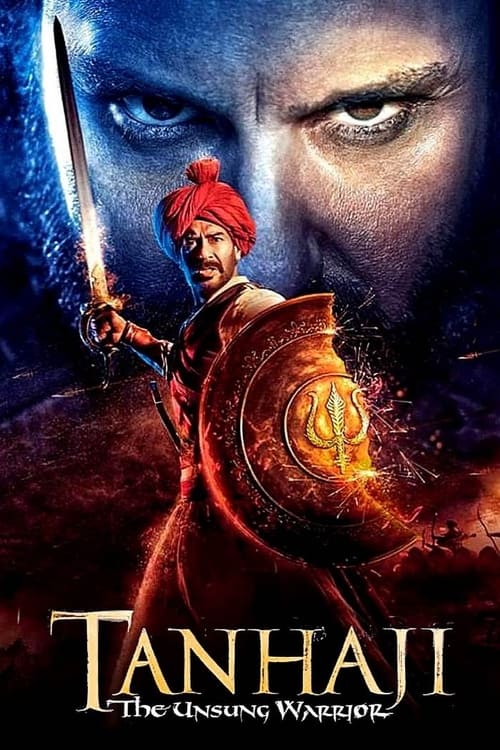
Tanhaji: The Unsung Warrior
Plot
When Aurangzeb recruits his trusted soldier Udaybhan to control the Kondhana fort, Shivaji's military leader Tanhaji Malusare and his army of Maratha warriors set out to recapture the fortress.
Get the Weekly Woke Watchlist
New and trending movies scored for woke bias, preachy messaging, and forced political themes — before you waste your evening.
No spam. One useful email per week.
Overall Series Review
Categorical Breakdown
The narrative explicitly frames the conflict around group identity, contrasting the righteous Maratha (Hindu) hero with the 'savage, brutal, ruthless outsiders' (Mughal-allied forces). The film is celebrated for its 'hyper nationalistic climate' and reinforces a sense of Hindu majoritarian identity representing 'dharma' against the external threat. However, characters are judged by their actions and competence within this nationalistic framework, and the core conflict is *antithetical* to the Western Intersectional Lens (no vilification of 'whiteness,' no anti-Western themes, no enforced diversity lecture). A low score is assigned because the overall political message directly opposes the typical tenets of the 'woke mind virus' framework.
The movie is the antithesis of civilizational self-hatred. It is driven by a 'hyper nationalistic' sentiment, celebrates 'India's glorious past,' and promotes 'Maratha pride'. The core motivation is the defense of home culture and land (Swaraj) and the honoring of ancestors' sacrifices. The home culture is presented as righteous and moral (representing 'dharma') in opposition to the invaders, directly reflecting the 'Gratitude & Chesterton’s Fence' definition.
The film operates in a 'testosterone driven world' where women hold distinctly 'secondary roles'. The main female characters, such as Tanhaji's wife, are portrayed as 'devoted' and entirely supportive of the hero's protective, hypermasculine mission, linking female honor to the male warrior's success. The themes celebrate traditional family structure and protective masculinity, with no presence of the 'Girl Boss' trope or anti-natalist messaging. This perfectly aligns with the 'Complementarianism & Vitality' extreme.
The story strictly adheres to a 'Normative Structure,' centered on the male-female pairing, the nuclear family (Tanhaji is a loving husband and father who leaves his son's wedding for duty), and traditional gender roles. There is no centering of alternative sexualities, no deconstruction of the nuclear family, and no gender ideology present in the narrative.
Faith is a central and positive motivator for the protagonists. Tanhaji is depicted as a man of faith, and his cause is heavily interwoven with the defense of 'dharma' and 'Bhagwa' (saffron flag). The conflict is framed as a moral battle where the Maratha side represents a higher, objective moral law and faith is a source of strength, directly opposing the idea of a 'Spiritual Vacuum.'
Get the Weekly Woke Watchlist
New and trending movies scored for woke bias, preachy messaging, and forced political themes — before you waste your evening.
No spam. One useful email per week.