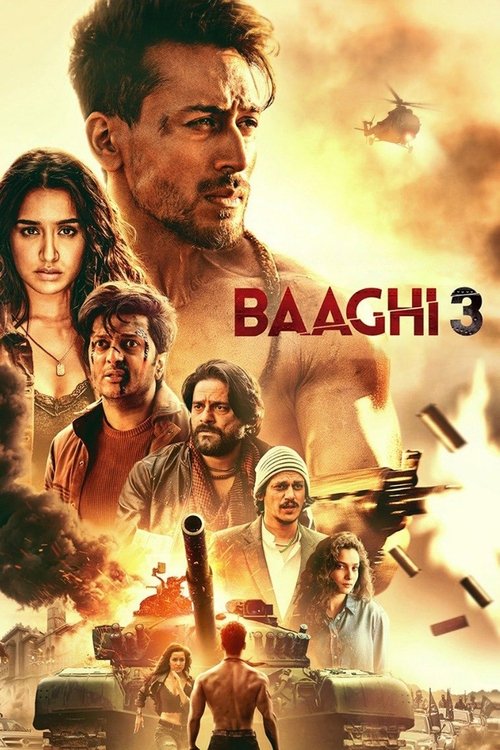
Baaghi 3
Plot
A man embarks on a bloody rampage to save his kidnapped brother.
Get the Weekly Woke Watchlist
New and trending movies scored for woke bias, preachy messaging, and forced political themes — before you waste your evening.
No spam. One useful email per week.
Overall Series Review
Categorical Breakdown
The narrative is a universal story of a brother’s love and a singular hero’s merit-based strength to save his family. The hero's actions are defined by his physical and moral capability, not by any immutable characteristics or class hierarchy. The antagonists are a terrorist organization in a foreign country, not a vilification of an 'oppressor' class like 'whiteness' or internal Indian systems.
The film centers on a heroic Indian man who travels abroad to rescue an Indian police officer (his brother) from a foreign terrorist group. The dialogue includes jingoistic lines about wiping a country off the map to save his family, which is the direct opposite of civilizational self-hatred. It reinforces family and national bonds as the central value.
The film is an extreme glorification of traditional masculinity, featuring a constantly bare-chested male protagonist who embodies brute force and 'deadly machismo' as the ultimate solution. The older brother is depicted as timid and incompetent, highlighting the hero's protective role. The main female character is a sidekick, described as providing comic relief and being 'not very crucial to the story,' which is contrary to the 'Girl Boss' trope. The core family unit is traditional, with the two brothers marrying two sisters.
The core relationships in the film are the heterosexual pairings of the two brothers with the two sisters. There is no presence of alternative sexualities, deconstruction of the nuclear family, or discussion of gender theory. The structure is entirely normative.
The primary villains are a radical terrorist organization, which is a critique of a fundamentalist, violent political ideology masquerading as a religious group. This is not an attack on traditional religion or faith itself. The hero's moral compass is fixed on the objective truth of protecting his family, not on moral relativism.
Get the Weekly Woke Watchlist
New and trending movies scored for woke bias, preachy messaging, and forced political themes — before you waste your evening.
No spam. One useful email per week.